

.svg)
.svg)
Lead Enrichment: How to turn raw contacts into sales-ready leads
%20(7)-p-2000.jpeg)
Generate B2B Leads with AI?
With LeadScraper, you create suitable B2B lists in seconds. 100% GDPR compliant. No subscription required!
CREATE TEST ACCOUNTSales teams spend hours every day researching contact data, matching LinkedIn profiles, and gathering company information, yet emails still end up with the wrong contacts or phone numbers that are long outdated. Lead Enrichment solves precisely this problem by automatically enriching existing contact data with relevant additional information.
In this article, you will learn how lead enrichment works, what data is enriched, and which tools are 2026 truly worthwhile. You will also learn why AI agents are fundamentally changing data enrichment right now and how you can leverage this for your B2B sales.
- Lead enrichment automatically supplements existing contact data with company data, contact persons, and industry information. Without regular data enrichment, around 25% of your B2B database becomes outdated each year.
- Enriched leads convert better because you can tailor your approach, timing, and channel to each individual contact.
- Lead enrichment is possible in a GDPR-compliant way, as long as you use exclusively publicly accessible sources and document the origin.
What is Lead Enrichment?
Lead enrichment, or data enrichment, describes the process of supplementing existing lead data with additional information. A name and an email address are transformed into a complete profile including company, industry, company size, decision-maker role, and contact details.
The distinction from related terms is easily explained. Lead generation brings in new contacts. Lead enrichment makes these contacts usable. And lead scoring then evaluates them, although meaningful scoring is hardly possible without enriched data.
Here's a concrete example: You receive the name via a form "Thomas Müller" and the email „[email protected]". After enrichment, you know that Thomas is the managing director of a mechanical engineering company with 120 employees in Stuttgart, that the company is currently expanding, and uses HubSpot as its CRM.
With this information, you can approach him specifically instead of sending a generic email that ends up in the trash.
Why Lead Enrichment is Crucial in B2B Sales
B2B data becomes outdated quickly. According to a HubSpot study, without regular data enrichment, around 2% of all B2B contact data becomes unusable each month. After one year, a quarter of your database is outdated. People change jobs, companies change addresses, and phone numbers are reassigned.
The result: Bounce rates of 5 to 10% in email campaigns, calls to people who have long since moved on, and sales reps spending their time on research instead of selling. Especially in outbound sales , data quality determines whether a campaign succeeds or fails.
Lead enrichment directly counteracts this. Enriched leads convert better because the approach is more personalized and relevant. If you know what software a company uses, what challenges the industry is currently facing, and who makes the decisions, you can tailor your message precisely to that.
Instead of "Hello, we offer solution X," it becomes " Hello Thomas, as a managing director in mechanical engineering, you're familiar with problem Y. Here's how we solve it."
And another point that is often underestimated: Lead scoring only works properly when the underlying data is accurate. Evaluating a lead by company size, industry, and purchase intent requires that this information is available in the first place.
What data is enriched during lead enrichment?
Not all information is equally relevant. Which data you should enrich depends on your sales process and your ideal customer profile (ICP) .
| Data Type | Examples | Benefit in Sales |
|---|---|---|
| Contact data | Email, phone, LinkedIn profile | Direct access to the decision-maker |
| Company data | Industry, employee count, revenue, location | Does the company fit your ICP? |
| Technographic data | Software in use, tech stack, CRM | Identify compatibility and pain points |
| Intent data | Search behavior, content downloads, website visits | Assess purchase readiness |
| Behavioral data | Email opens, clicks, event participation | Measure engagement level |
| Demographic data | Job title, department, seniority | Identify the right contact person |
In practice, firmographic and contact data are the starting point. Without a correct email and the right contact person, even the best sales process is useless. Technographic and intent data come into play when you want to personalize your outreach even more precisely.
An example: You sell a project management tool. If you discover through technographic data that a company currently uses Trello, and at the same time intent data shows they are searching for "Trello Alternative," you have a hot lead with a concrete hook for your outreach.
How does lead enrichment work in practice?
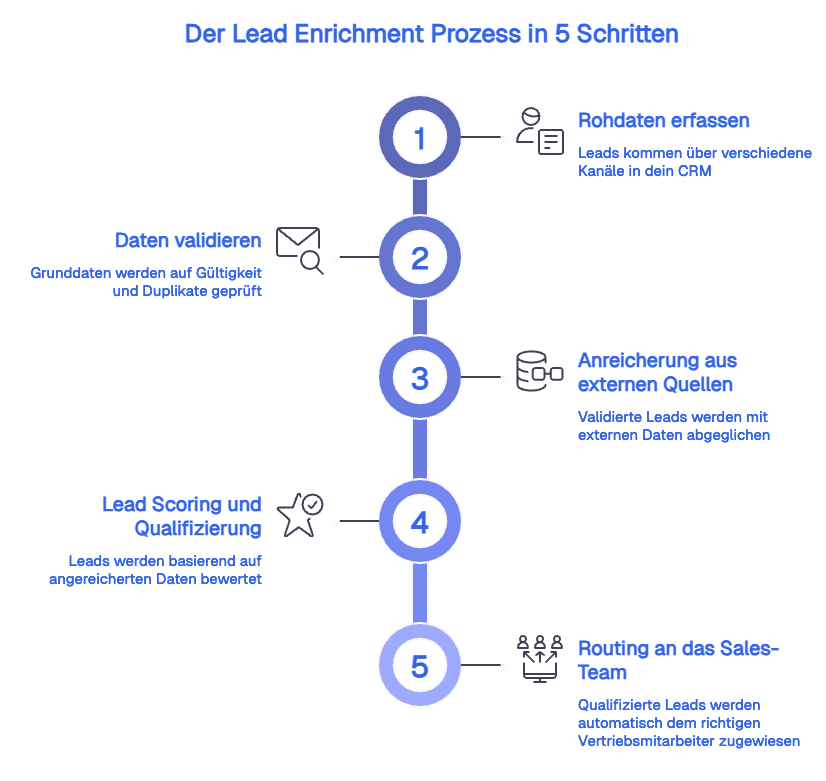
At its core, the process consists of five steps, ideally automated.
Step 1: Capture raw data.
Leads come in through various channels, whether web forms, trade show visits, LinkedIn, or purchased lists. This raw data ends up in your CRM or a spreadsheet.
Step 2: Validate data.
Before enriching, you check the basic data. Is the email address valid? Are there duplicates in your database? This step prevents you from wasting time and credits on invalid contacts.
Step 3: Enrichment from external sources.
Now the actual enrichment takes place. The validated leads are matched against external data sources, whether company databases, LinkedIn, corporate websites, or specialized data providers. This is where tools like Clay, Apollo, or LeadScraper.de come into play.
Step 4: Lead scoring and qualification.
Based on the enriched data, you evaluate each lead. Does the company size fit? Is the industry correct? Does the contact have decision-making authority? Leads that match your ICP receive high priority.
Step 5: Routing to the sales team.
Qualified leads are automatically assigned to the appropriate sales representative, based on region, industry, or deal size. The faster a good lead reaches the right salesperson, the higher the probability of closing.
This entire process can be automated with tools like n8n or Zapier fully automated. From form submission to sales rep assignment, everything can happen without manual intervention.
Waterfall Enrichment – Data Enrichment from Multiple Sources
A concept that is still little known in the German B2B scene but makes a massive difference in data enrichment is Waterfall Enrichment.
The principle is simple. Instead of relying on a single data source, you query multiple sources sequentially. If Source A doesn't find the desired email address, Source B is automatically queried. If that also yields no result, it moves on to Source C. Only when all sources have been exhausted is the lead marked as non-enrichable.
Why is this so relevant? No single data provider has complete coverage. Apollo might be strong for the US market but deliver incomplete data for German SMEs. Cognism has good European mobile numbers but doesn't cover every niche industry. And while LinkedIn data is current, email addresses are completely missing there.
Tools like Clay have built-in Waterfall Enrichment as a core feature. You define a sequence of data sources, and Clay automatically processes them until a result is found. The result is significantly higher hit rates than with any single source alone.
This is particularly relevant for the German market because many international tools have gaps in DACH company data . Combining multiple sources for data enrichment circumvents this problem.
AI-powered Lead Enrichment with AI Agents
The biggest disruption in lead enrichment is currently happening through AI agents. Instead of querying static databases, AI agents search the internet in real-time and gather up-to-date information directly from company websites, industry directories, and public profiles.
The difference from traditional tools is significant. Apollo or Cognism access their own databases, which are updated regularly but not in real-time. AI agents, however, research live with every query. The result is data that is current at the time of the query, not weeks or months old.
Two approaches can be distinguished here.
General AI tools like Claude or OpenClaw
Claude is well-suited for analyzing websites of potential customers, summarizing information, or preparing research results. OpenClaw goes a step further and can research and prioritize leads as an autonomous agent. Both tools provide helpful support for preliminary research and strategy. However, they are not designed for large-scale data enrichment. You have to formulate prompts yourself, manually transfer results, and there's no built-in duplicate checking or email validation. This is not an issue for individual leads, but impractical for hundreds per week.
Specialized solutions like LeadScraper
LeadScraper.de deploys hundreds of AI agents that search the internet in real-time for suitable company contacts. Unlike general AI tools, LeadScraper.de specializes in data enrichment. The AI agents work systematically, deliver results in a consistent format, and as exportable lists. Instead of rigid dropdown filters, you describe who you're looking for in free-text fields, and the AI semantically interprets what you mean. This works particularly well for specific niche target groups which simply don't exist as filter categories in traditional databases.
Our assessment: General AI tools like Claude excel in strategy, research, and text-related tasks for sales. For systematic data enrichment in daily operations, you need a specialized tool like LeadScraper.de, which provides structure and scalability. Technology is evolving rapidly. With every tool, check if the results are accurate for your specific market and target audience.
The best tools for Lead Enrichment and Data Enrichment 2026
The B2B lead enrichment market is vast and complex. To save you hours of comparison, here you'll find the most important lead enrichment tools with real prices and an honest assessment.
| Tool | Focus | Price | Strength | Weakness |
|---|---|---|---|---|
| Clay | Enrichment workflows across 100+ data sources | from $149/mo (unlimited users) | Waterfall enrichment, flexible automation | Steep learning curve, no built-in email sending |
| LeadScraper.de | AI-powered real-time lead research | Credit-based | Free-text search, custom lists, GDPR-compliant | Still a young product |
| Apollo.io | Lead database with integrated outreach | from $59/user/mo | Large database, built-in email sending | Data often outdated, bounce rates 5-10% |
| Cognism | Verified direct dials and mobile numbers | Enterprise pricing | Strong DACH coverage, verified phone data | Expensive, better suited for larger teams |
| Clearbit | Firmographic data enrichment via API | Enterprise pricing | Strong company data, easy integration | Rather US-focused |
| Lusha | Fast contact data via browser extension | from $36/user/mo | Easy to get started, usable directly from LinkedIn | Limited data scope |
Choosing the right tool depends on your setup. If you have a small team and want to get started quickly, Apollo is a pragmatic entry point, even if the data quality isn't always convincing. For teams that value clean data and flexible workflows, Clay is the stronger choice, though with a steeper learning curve.
If you primarily need fresh, individually researched leads instead of data from an existing database, it's worth looking into LeadScraper.de. Especially for specific niche target groups in the DACH region who are underrepresented in large international databases.
In our experience, most successful sales teams don't rely on a single tool but combine two to three. For example, LeadScraper.de for initial lead research, Clay for multi-source enrichment, and their CRM for management and outreach.

Automate Data Enrichment – How to Connect Your Tools
You've now selected an enrichment tool or combined several. But how does the enriched data automatically get to where your sales team works?
Your CRM is the central hub. Whether it's HubSpot, Pipedrive, or Salesforce, enriched data needs to land in the contact profile there, not in a separate spreadsheet.
Many enrichment tools offer native CRM integrations, so new fields are automatically written to the correct profile.
For anything not natively integrated, there are middleware tools like n8n or Zapier. A typical automated enrichment flow looks like this:
- New lead comes in via a web form
- Email address is automatically validated
- Company data is enriched via an enrichment API
- Lead score is calculated
- Lead is assigned to the appropriate salesperson in the CRM
- Automatic follow-up is triggered
n8n is particularly popular in the German community because it's open source, can be self-hosted, and no data flows to third-party providers. This is a relevant point for data-sensitive B2B companies.
Don't start with the entire flow at once. The first step is usually email validation and firmographic data enrichment. You can gradually build out the rest.
GDPR and Data Enrichment – What is Permitted?
In the DACH region, data protection plays a central role in lead enrichment. The lines between permissible data enrichment and data protection violations are narrower than many think.
The good news: Lead enrichment is generally GDPR-compliant possible. The legal basis in most cases is legitimate interest according to Art. 6 Para. 1 lit. f GDPR. This means you may use publicly available data such as company websites, commercial register entries, or industry directories to enrich your leads, as long as your company's interest does not outweigh the data subject's interest in protection.
Four points are particularly crucial here.
- Only use publicly available sources. Company websites, imprint data, commercial registers, and industry directories are generally unproblematic. Private social media profiles or protected databases are not.
- Ensure transparency. Data subjects must be able to find out where you obtained their data from. It's best to document the source for every enriched data point.
- Enable the right to object. Every contact must have the option to object to the use of their data.
- Regularly review and delete data. Outdated or no longer needed data should be deleted, not just archived.
LeadScraper.de works exclusively with publicly available data sources and transparently documents the source for every generated contact. No personal data is purchased or resold.
If you are unsure whether your enrichment process is GDPR-compliant, have it reviewed by a data protection officer. This is not bureaucratic overkill, but protects you from fines and reputational damage.
Common Mistakes in Data Enrichment
Even with the best tools, data enrichment can be done wrong. These four mistakes are the most common we encounter in practice.
1) Too many tools without a clear strategy.
One tool for email validation, one for company data, one for phone numbers, one for intent data. This sounds like good coverage, but often leads to data chaos because the systems aren't properly connected. Fewer tools, but well-integrated ones, yield better results.
2) Anyone enriching data without knowing their ICP is collecting useless data.
First, define which companies and contacts you're looking for. Then enrich. This order sounds obvious, but it's surprisingly often ignored.
3) Never check data quality.
Enrichment tools don't always provide accurate results. Spot checks after every major enrichment run are essential. Anyone who blindly trusts automatically enriched data risks incorrect outreach and a damaged sender reputation.
4) And a point that can be costly, especially in the DACH region: Ignoring GDPR.
Enriching data from questionable sources or not offering an opt-out option can ultimately lead to not only fines but also the loss of trust from potential customers.
Conclusion
Lead enrichment will be mandatory in 2026 for every B2B sales team that wants to work data-driven.
Our recommendation: Start with a clear ICP and a simple, automated workflow. Enrich the data your sales team actually needs for outreach, and expand gradually. The trend is clearly moving towards real-time data enrichment by AI agents, which are increasingly replacing static databases.
Those who address this now will have a real advantage in 2027. If you're specifically looking for leads in the DACH region that are missing from large international databases, try LeadScraper.de.
%2520(7).jpeg)
%20(7).jpeg)