
.svg)
.svg)
Buy B2B Leads in 2026: What Can Go Wrong
%2520(7).jpeg)
Generate B2B Leads with AI?
With LeadScraper, you create suitable B2B lists in seconds. 100% GDPR compliant. No subscription required!
CREATE TEST ACCOUNTYour sales team needs new contacts, preferably yesterday. Buying B2B leads sounds like the quickest solution: order a list, start outreach, generate revenue.
However, anyone buying leads in 2026 without understanding the underlying principles is highly likely to burn money.
This guide shows you how lead purchasing actually works, where the real pitfalls lie, and why AI-powered alternatives are increasingly replacing the classic approach.
- Buying B2B leads works in principle, but the quality varies enormously because cheap lists are rarely exclusive and quickly become outdated.
- Purchased leads convert at an average of 1 to 2 percent, while self-generated leads reach 10 to 15 percent.
- Around 30 percent of all contact data in lead lists becomes outdated each year, and without regular updates you are paying for dead records.
How Lead Purchasing Works in Practice
If you want to buy B2B leads, there are essentially three models available to you, which differ significantly not only in price but also in data quality and long-term usability.
One-time Lists vs. Database Subscription vs. Pay-per-Lead
- One-time Lists are the classic approach. You pay a fixed amount, receive a CSV or Excel file with company addresses and can use it freely. The disadvantage, however, is obvious: From the moment of purchase, the data becomes outdated, and after six to twelve months, a significant portion is no longer current.
- Database Subscriptions give you permanent access to a contact database, where you can filter by industry, region, company size, and other criteria. The data is regularly updated, for which you pay a monthly or annual fee.
- Pay-per-Lead means you only pay for contacts actually delivered. That sounds fair, but it's often more expensive than it first appears, especially if the lead quality isn't right and you end up paying for contacts that never convert.
How much does a B2B lead cost?
Price ranges vary widely. Simple company addresses with a name, industry, and phone number start at around 15 cents per record, while qualified leads with a verified contact person at decision-maker level can cost up to 120 Euros. What is considered a normal price per lead in your industry heavily depends on the level of qualification.
However, these figures alone don't tell the whole story, because the price per usable contact is what truly matters. An example calculation illustrates this:
You buy 500 leads for 2 Euros each, totaling 1,000 Euros. With a conversion rate of 1 to 2 percent, you'll get 5 to 10 contacts that actually lead to a conversation. The effective price per usable lead is therefore 100 to 200 Euros. That's a completely different calculation than the 2 Euros on the offer.
Benefits of purchased B2B leads
Buying leads certainly has its merits, and there are situations where purchasing is the right approach.
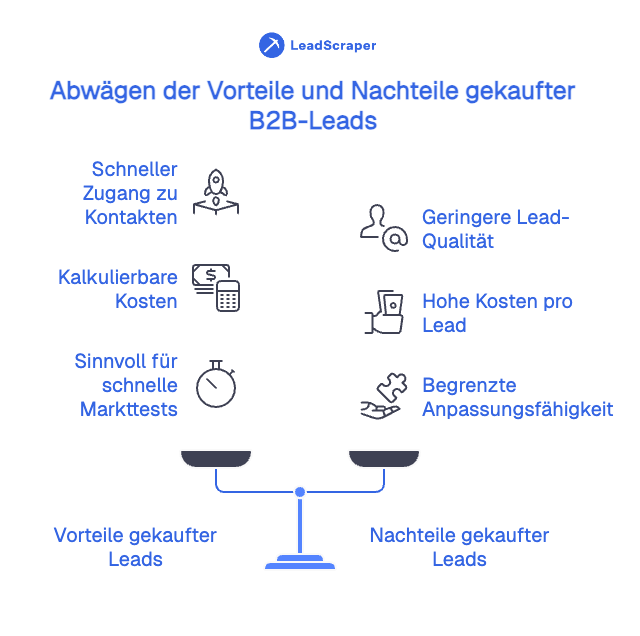
Quick access to contacts
You don't need weeks or months to build a pipeline, because a purchased list is ready for immediate use. For new sales representatives or entering a new market, this can be a sensible starting point.
Pre-segmentation
Good providers deliver leads that are already filtered by industry, region, company size, or decision-maker level, which saves you a lot of research time.
Predictable costs
You know beforehand what you're paying, and that simplifies budget planning, especially for one-off campaigns or market tests.
Ideal for rapid market testing
If you want to test a new product or a new target group, a purchased list can quickly show you if your approach works, without having to build up organic leads for months beforehand.
The problems with buying leads that hardly anyone talks about
Most providers emphasize the advantages, and you often only learn about the disadvantages after the money has already been spent. Here are the four biggest problems with B2B lead purchasing that repeatedly arise in practice.
Exclusivity? Not a chance.
In our experience, this is the biggest problem. Most lead lists are not sold exclusively, and your competitors buy the same list from the same provider. In the worst case, three or four companies contact the same person in the same week.
What happens next is predictable: The contact is annoyed before you even call, and you end up in a race where the first one to pick up the phone wins. This has little to do with strategic sales.
Some providers promise exclusivity and charge a high price for it. But even then, there's no guarantee that the same data won't be sold again through other channels or at a later date.
Data Decay: 30 percent decay annually
Contact data has an expiration date, because people change jobs, companies merge, and phone numbers change. Industry studies estimate that around 30 percent of all B2B contact data becomes outdated each year.
Specifically, this means: A list you buy today will be almost one-third unusable in a year. With a one-time list without updates, you automatically pay for data sets that will be worthless in just a few months. Database subscriptions with regular updates mitigate the problem, but don't solve it completely.
Conversion Reality
Purchased leads convert at an average of 1 to 2 percent, while leads generated through your own channels (content, SEO, LinkedIn, events) are at 10 to 15 percent.
The reason is simple. A purchased lead doesn't know you, hasn't signaled interest, hasn't filled out a form, and hasn't read an article. You're starting from scratch. In contrast, with a self-generated lead, there's already a touchpoint, a basic interest, and a context for the conversation.
This doesn't mean purchased leads never work, but you need many more contacts to achieve the same number of conversions.
What to look for when buying B2B leads
If you still decide to buy leads, you should definitely check a few things before investing money. The most important thing is not to blindly follow the cheapest offer.
- Ensure GDPR compliance. Specifically ask the provider where the data comes from and if there's a legally compliant basis for its use. As the buyer, you are jointly responsible if the data was collected unlawfully, so have the legal basis confirmed in writing. What exactly GDPR-compliant lead generation what this means in practice, we have summarized in our own guide.
- Question the data's recency. When was the list last updated, and how often does the provider check its datasets? If there's no clear answer, caution is advised.
- Secure exclusivity contractually. If exclusivity is important to you, a verbal promise isn't enough. Get it in writing in the contract and also check for any time restrictions.
- Trial package before a large purchase. No reputable provider has a problem with selling you a small test quantity first. If you're expected to buy a large package immediately without being able to check the quality beforehand, that's a red flag.
- Check provider reputation. Look for reviews, ask for references, and see how long the provider has been in the market. Unrealistic promises like "guaranteed conversions" or "100 percent up-to-date data" are almost always a bad sign.
Common Mistakes When Buying B2B Leads
Even if the data quality is good, many companies make avoidable mistakes when handling purchased leads.
Focusing Solely on the Unit Price
500 leads for 100 Euros sounds good, but if only 5 of them lead to a conversation, the deal was expensive. What's crucial isn't the price per dataset, but the price per result.
Failing to Plan a Test Phase
Anyone who starts directly with a large list and launches the entire outreach machinery risks a lot. It's more sensible to first test 50 to 100 leads, evaluate the results, and then scale up.
Ignoring GDPR
Sounds obvious, but it happens constantly. Especially with cheap providers, the origin of the data is often unclear, and a fine or warning is significantly more expensive than the supposedly saved costs.
Not Securing Exclusivity Contractually
Many assume that their leads are sold only to them. Without a contractual agreement, that's just wishful thinking.
Contacting purchased leads without personalization
A generic email to a cold contact almost never works. Those who use purchased leads must put more effort into their outreach, not less, because without personalization and relevance, the message ends up in the trash.
The Alternative: AI-powered Lead Generation Instead of Static Lists
Traditional lead purchasing has a structural problem: You get a snapshot, a list that might have been current at the time of creation, but is outdated from that moment on. Furthermore, it's often not exclusive and has no relevance to your specific needs.
AI-powered tools take a different approach. Instead of relying on an existing database, they search the internet in real-time for suitable contacts, which fundamentally differs from the traditional lead database approach .
LeadScraper.de works exactly like that. Hundreds of AI agents simultaneously research the web and deliver customized lead lists with company name, website, email, phone number, and the right contact person.
In practice, it works like this: You specify who you're looking for, and the AI provides suitable contacts. But the differences from traditional lead purchasing run much deeper:
- Free text instead of rigid filters: You describe in your own words who you are looking for, not through dropdown menus and predefined categories, but in free-form text. This also allows for very specific target groups that would not be filterable in traditional databases, for example, "dental practices specializing in private patients and offering digital impressions."
- Every list is unique: The results are freshly generated and not pulled from an existing database. No one else gets your exact list, which completely eliminates the exclusivity problem.
- Learning AI: After each query, you can rate results, thumbs up or thumbs down. This feedback is directly incorporated into the search and filtering logic, and with every use, the algorithm becomes more precise.
- GDPR-compliant: LeadScraper.de works exclusively with publicly available data sources such as company websites, industry directories, and public profiles. No purchase or resale of personal data, and every generated contact has a transparent source attribution.
| Criterion | Classic Lead Purchase | LeadScraper.de |
|---|---|---|
| Data source | Static database or broker list | Real-time research on the internet by AI agents |
| Recency | Outdated from the moment of purchase (approx. 30% decay/year) | Freshly generated with every request |
| Exclusivity | Same list goes to multiple buyers | Every list is unique and individual |
| Filter logic | Rigid dropdowns (industry, region, size) | Free-text prompts, also for niche target groups |
| Learning effect | None, static records | Thumbs-up/down feedback trains the algorithm |
| GDPR | Depends on the provider, often non-transparent | GDPR-compliant, exclusively publicly accessible sources |
| Cost model | Per record or subscription with commitment | Credit-based, no subscription commitment |
| Suitable for | Quick market tests, simple target groups | Complex lead requirements, specific niches |
Who benefits most from this? Companies with more complex lead requirements.
Not "Give me all tax advisors in Germany," but "Find IT service providers with 20 to 100 employees who specialize in SMEs and currently offer cloud migration." These kinds of specific requests are exactly where AI-powered lead generation excels.
Conclusion
Buying B2B leads in 2026 is not a bad approach per se. It can work for quick market tests, entering a new target audience, or as a short-term boost.
In the long run, however, the weaknesses become apparent: lack of exclusivity, rapidly outdated data, low conversion rates, and the risk of reputational damage. Companies that permanently build their sales efforts on purchased lists constantly struggle against declining data quality.
The better strategy for 2026 is to focus on methods that provide you with fresh, individual, and relevant contacts. AI-powered tools like LeadScraper bridge the gap between quick lead purchasing and time-consuming in-house research, offering you the speed of a purchased list with the quality and exclusivity of self-generated leads.
If you plan to have a bought list cold-called, first understand why hiring a call center to work through that list often gets expensive.
Frequently Asked Questions about Buying B2B Leads
Is it legal to buy B2B leads?
Yes, buying B2B leads is generally legal, as long as the data was collected in compliance with GDPR and a legal basis for processing exists. You should get written confirmation from the provider about where the data comes from
and that it can be lawfully used, because the responsibility lies not only with the provider, but also with you as the buyer.
How much does a qualified B2B lead cost?
Prices range from 15 cents for basic company addresses to over 100 Euros for qualified leads with verified decision-maker contacts. More important than the per-unit price, however, is the cost per usable contact, because with a conversion rate of 1 to 2 percent, a lead that costs 2 Euros on paper can effectively cost 100 to 200 Euros.
Buying leads or generating them yourself – which is better?
Both have their merits. Buying leads is fast but often less effective, whereas self-generated leads through content, SEO, LinkedIn, or events convert significantly better but require more time. AI-powered tools combine both advantages: fast availability with individual, up-to-date quality.
How to identify a reputable lead provider?
Look for transparent information regarding data origin, GDPR compliance, and regular data updates. Reputable providers have no problem offering a test package and communicate openly about their methods. You should avoid providers who make unrealistic promises or insist on upfront payment without a testing option.
Can I use purchased leads for cold emails?
No. In Germany, advertising via email without the recipient's prior express consent is prohibited under §7 (2) No. 3 UWG. This applies to B2B as well as B2C. The only exception is the so-called existing customer privilege (§7 (3) UWG), which requires that the recipient is already a customer and has provided their email address during a purchase. For purchased leads with whom no prior business contact exists, there is no legal basis for email outreach. Those who do so anyway risk warnings and fines.