
.svg)
.svg)
B2B Outbound Lead Generation 2026
%20(7).jpeg)
Generate B2B Leads with AI?
With LeadScraper, you create suitable B2B lists in seconds. 100% GDPR compliant. No subscription required!
CREATE TEST ACCOUNTYour sales team needs new conversations, not eventually, but now. While inbound strategies like SEO or content marketing take months to take effect, outbound lead generation delivers immediate results: You identify the right companies, specifically target decision-makers, and start conversations, instead of hoping someone finds your contact form.
But between "actively approaching leads" and "actively approaching the right leads" there's a huge difference.
This guide shows you how outbound sales truly works in 2026, which channels are worthwhile in B2B, and why the quality of your leads determines success or failure.
- Outbound lead generation means actively reaching out to potential customers instead of waiting for them to find you.
- The most common mistake is not the wrong technique but the wrong leads. If you contact the same people everyone else does, you get ignored.
- AI-powered tools fundamentally change outbound lead generation because they research individual contacts in real time instead of relying on static lists.
What is Outbound Lead Generation?
Outbound lead generation describes all measures where your sales team actively identifies and approaches potential customers. You don't wait for someone to visit your website or read a blog post. Instead, you go out and find the companies that fit your offering.
This is the key difference from inbound: With inbound, you attract prospects through content, SEO, or advertising (Pull). With outbound, you actively approach them (Push). Both have their merits, and the best sales strategies combine both approaches.
Crucially: Outbound is not synonymous with cold calling. Cold calling is one channel within an outbound strategy, but outbound encompasses much more, from LinkedIn messages and personalized email sequences to direct engagement at events.
When is outbound the right choice?
Outbound lead generation is particularly suitable when you can't wait months for inbound measures to take effect. Specifically, this means:
- You're building a new sales team and need a pipeline quickly.
- You're entering a new market or testing a new target audience.
- Your product or service requires extensive explanation and benefits from a personal conversation.
- Your target audience isn't actively looking for solutions because they aren't yet aware of the problem.
Conversely, outbound is less effective if your target audience is so broad that you can reach them more efficiently with content, or if your product is so inexpensive that individual outreach isn't financially viable.
The most important B2B outbound channels
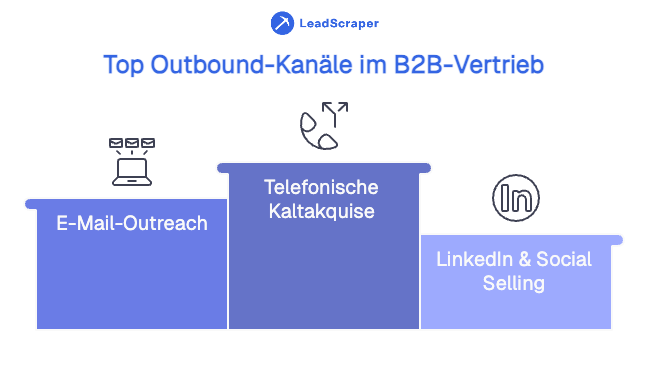
In B2B outbound sales, three channels have proven particularly effective. Which one works best for you depends on your target audience, product, and resources.
Cold Calling
The most direct approach. You call potential customers and try to initiate a conversation. In B2B, telephone cold calling is permitted under certain conditions, specifically when the called company is presumed to have an interest in your offer.
The advantage is that you get an immediate reaction and can address objections in real-time. The downside: The success rate is low; typically, you directly reach 2 to 5 percent of decision-makers, and many contacts find unannounced calls disruptive.
Telephone prospecting works best when you know who you're calling and why beforehand. A blind call to the first available contact in a company rarely yields results. However, a call to the right contact person with a specific reason often does.
Email Outreach
Email outreach doesn't refer to the classic newsletter, but rather individual, personalized messages to potential customers. In practice, this means: You directly contact an individual, state a specific reason for reaching out, and offer a clear next step.
Important: In Germany, it is Cold emailing prohibited without prior consent under §7 UWG, even in B2B. Those who do it anyway risk legal warnings. More on this in the GDPR section below.
Email outreach can still work, but only if you obtain prior consent, for example, via LinkedIn or a phone call. As a pure cold outreach channel, email is generally not an option in the German market, unless you already factor in legal warnings as an advertising expense.
LinkedIn & Social Selling
LinkedIn is the channel that has grown most significantly in B2B outbound over recent years. You connect with relevant individuals, interact with their content, and build a relationship before making a concrete offer.
The advantage here is that the barrier to entry is lower than with phone calls, and you can research the person beforehand. The downside: Many decision-makers are flooded with messages on LinkedIn daily, and generic inquiries end up unread in the trash.
Anyone who Social Selling on LinkedIn takes seriously needs a strategic approach and not copy-paste messages to a hundred contacts. This means: Build relationships first, then pitch. Not the other way around.
Outbound Lead Generation in 5 Steps
A structured outbound process distinguishes successful sales teams from those who randomly call contacts. These five steps form the framework for B2B outbound sales that delivers results.
1. Define Your Ideal Customer Profile (ICP)
Before you even approach a single contact, you need to know who you're looking for. Your Ideal Customer Profile describes the type of company that benefits most from your offering and simultaneously has the highest probability of closing.
Good ICPs go beyond "Industry X, Company Size Y" . They answer questions like: What problem does this company have? Why is it relevant right now? Who makes decisions, and what is important to that person?
The more precise your ICP, the less time you waste on companies that formally fit but currently have no need.
2. Research and qualify leads
This often becomes painful in practice. Sales teams spend hours compiling potential contacts. Browsing LinkedIn, scouring Google, clicking through industry directories, reading websites to find out if a company is even relevant.
And then comes the real problem: The contacts you find this way are also found by everyone else. The same companies end up on the same lists, are approached by the same sales teams, and eventually become saturated.
The quality of your outbound leads determines whether your sales team has conversations or talks to walls. More on this in the lead quality section below.
3. Personalize initial outreach
Generic messages don't work. Not on the phone, via email, or on LinkedIn. The recipient immediately notices whether you've researched their company or if you're sending the same message to 200 contacts.
Good personalization doesn't mean inserting the company name into a template. It means having a specific point of reference: a current project, a job posting that indicates a specific problem, or an industry trend affecting the company.
4. Build a follow-up sequence
Most deals don't happen on the first contact. Studies show, that on average five to eight touchpoints are needed before a prospect is ready for a conversation.
Nevertheless, many sales representatives give up after the first or second attempt. A well-thought-out follow-up process across multiple channels is therefore not a nice-to-have, but a must.
Each follow-up should offer a new reason or new information. Simply saying "I just wanted to follow up again" isn't a follow-up; it's annoying.
5. Measure and optimize results
Without data, you don't know if your outbound efforts are working. The most important KPIs are:
- Contact Rate: How many of your target contacts do you actually reach?
- Response Rate: How many respond to your outreach?
- Meeting Rate: How many contacts lead to a qualified conversation?
- Conversion Rate: How many conversations turn into closed deals?
If your contact rate is high but your response rate is poor, the problem lies with your outreach. If the response rate is good but the meeting rate is low, your qualification process isn't right. Numbers show you where you need to make adjustments.
Why Lead Quality Determines Your Outbound Success
This is the point most guides skip. They talk about techniques, scripts, and tools. But the truth is, the best outbound technique won't help if you're targeting the wrong people.
In our experience, poor lead quality is the most common reason why outbound sales fail. Not a lack of technique, not a weak script, but simply the wrong contacts.
The problem has two dimensions:
- Time spent on research. Sales teams often spend more time searching for contacts than actually selling. If you spend two hours researching to find ten contacts, you have a structural problem, because that time is then unavailable for conversations and closing deals.
- Everyone finds the same leads. Anyone searching on Google, LinkedIn, or in industry directories will find the same companies as everyone else. These contacts are being approached by multiple sales teams simultaneously, making them significantly harder to reach. Your outreach gets lost in a flood of similar messages, and the chance of a response decreases with every competitor who contacts the same lead.
Outbound lead generation will only work reliably in 2026 if you find ways to identify contacts that aren't on every other sales list.
The Alternative: AI-powered lead generation instead of manual research
There is indeed a way, and it starts exactly where manual research reaches its limits .
We're talking about AI-powered tools. Instead of relying on static databases or manual searches, they research in real-time and deliver individualized results. This fundamentally differs from the classic lead database approach, where all customers draw from the same pool.
LeadScraper.de works exactly on this principle. Hundreds of AI agents simultaneously scour the internet and deliver individualized lead lists with company name, website, email, phone number, and the right contact person.
Manual Outbound Research vs. AI-Powered: A Comparison
| Kriterium | Manuelle Recherche | KI-gestützt (LeadScraper.de) |
|---|---|---|
| Zeitaufwand | Stunden pro Leadliste | Minuten pro Leadliste |
| Exklusivität | Gleiche Quellen wie der Wettbewerb | Einzigartige, frisch generierte Ergebnisse |
| Spezifität | Begrenzt auf verfügbare Filter | Freitext-Prompts für beliebige Nischen |
| Aktualität | Abhängig von der Quelle | Echtzeit-Recherche im Internet |
| Lerneffekt | Keiner | Feedback-Loop trainiert den Algorithmus |
| DSGVO | Eigenverantwortung bei jeder Quelle | Nur öffentlich zugängliche Daten |
| Geeignet für | Kleine, einfache Zielgruppen | Komplexer Leadbedarf, spezifische Nischen |
Conclusion
Outbound lead generation remains one of the most effective ways for B2B companies to actively acquire new customers in 2026. That hasn't changed. What has changed are the demands on its execution.
Generic mass outreach, poor data, and indiscriminate contact lists no longer yield results. Outbound works when three things are right: a clear ICP, the right contacts, and a personalized approach.
The decisive factor here is lead quality. Anyone who spends hours researching the same contacts as everyone else starts every outbound attempt at a disadvantage. AI-powered tools like LeadScraper.de solve precisely this problem by generating unique, fresh outbound leads in real-time that no one else has. This way, you start every outreach with an advantage instead of being in a race against the competition.
Frequently Asked Questions about Outbound Lead Generation
What is the difference between Outbound and Inbound Lead Generation?
With outbound lead generation, your sales team actively approaches potential customers, for example, through phone calls, LinkedIn messages, or personalized emails. With inbound, prospects come to you on their own, for instance, through Google searches, blog articles, or social media content. In practice, a combination of both approaches works best, with outbound delivering faster results and inbound being more cost-effective in the long run.
Is Outbound Sales still relevant in B2B?
Yes, but the approach needs to change. Generic mass outreach without personalization will hardly work in 2026. Outbound remains effective when the contacts being addressed are truly relevant and the outreach is individually tailored to the recipient. What's crucial is not the channel, but whether you reach the right people with the right message.
Which outbound channels work best in B2B?
That depends on your target audience. Cold calling is the most direct approach and is legal in B2B under certain conditions. LinkedIn is well-suited for building relationships with decision-makers. Email outreach is theoretically scalable, but in Germany, it's not legally permissible without prior consent. Most successful outbound teams combine several channels in a well-thought-out sequence.
How many follow-ups are advisable for outbound outreach?
Studies show that it takes an average of five to eight touchpoints before a prospect responds to outbound outreach. Most sales representatives give up after one or two attempts, missing out on a large portion of potential conversations. However, each follow-up should offer a new reason or additional information; otherwise, it comes across as intrusive.
%2520(7).jpeg)