
.svg)
.svg)
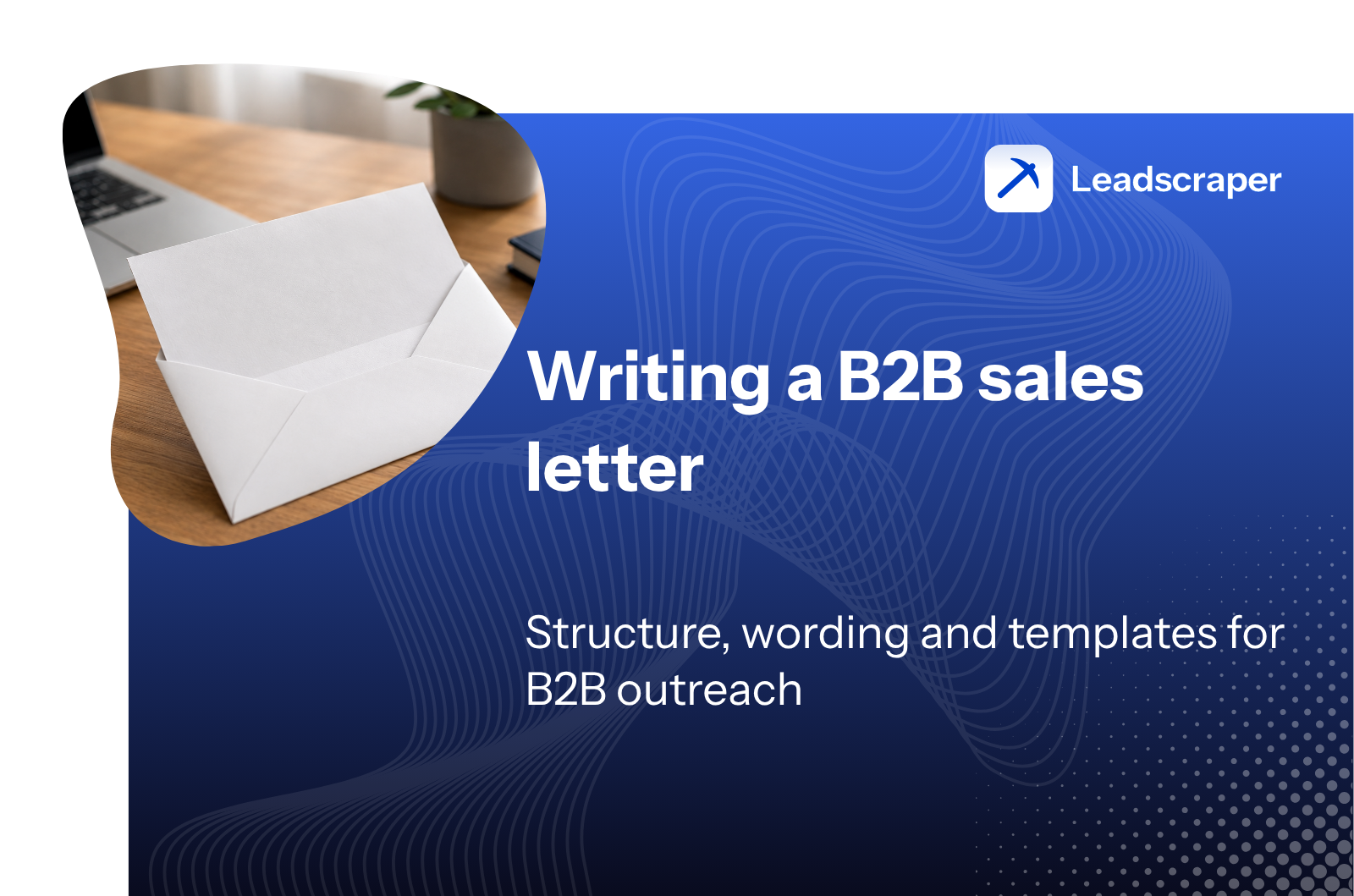
Writing a Sales Letter: Structure, Wording and Templates for B2B Acquisition

Generate B2B Leads with AI?
With LeadScraper, you create suitable B2B lists in seconds. 100% GDPR compliant. No subscription required!
CREATE TEST ACCOUNTA well-crafted sales letter lands where emails have long since drowned: on the decision-maker's desk. While the inbox overflows with newsletters and offers every morning, physical letters barely reach anyone in B2B anymore. That is exactly what makes them one of the last channels where a personally written letter actually gets read. Provided it is written well.
This guide walks you through, step by step, how a sales letter for winning new customers is built, which wordings work and which put people off. On top of that, you get three templates to copy, the most common mistakes and a legal overview of what is allowed in B2B.
- A sales letter persuades by speaking to the recipient rather than about the sender. The benefit to them comes before any self-presentation.
- The structure follows a clear chain: subject line, personal salutation, hook, benefit, proof and one single, concrete next step.
- A researched reason in the first sentence decides whether the letter gets read on or set aside. A mass letter with no connection does not work in B2B.
- Personalised letter advertising to companies is permitted in many EU countries even without prior consent. That is the legal difference from email and phone.
- A letter is only ever as strong as the address behind it. Researching the right companies and contacts saves most of the wasted reach.
What a sales letter is and when it beats email
A sales letter is a physically mailed cover letter that presents an offer and aims to move the recipient to respond. In B2B it almost always aims at starting a conversation: a callback, a meeting, an enquiry. The letter is the door-opener for the actual sales conversation.
Whether to send a letter or an email comes down to the circumstances. Both channels have their own strengths.
Strengths of the sales letter
Lands physically on the desk, barely any competition in the inbox, high attention, feels more valuable and is legally simpler in B2B than email or a call.
Strengths of email
Cheap per contact, scalable in minutes, measurable through opens and clicks, directly linkable. In return, an overcrowded inbox and stricter rules for cold outreach.
The letter pays off above all with a manageable, clearly defined target group of high order value, that is, wherever a few right decision-makers matter more than sheer volume. For a mailing to a few hundred selected companies, it plays to its strengths. For a deeper look at the channel including postage, formats and response rates, see the guide on B2B direct mail.
The structure of a sales letter
An effective sales letter follows a logical chain. Each building block has a job and leads to the next. The classic AIDA principle has proven itself: first attention, then interest, then desire, then action. In concrete terms, it looks like this.
- Subject line and hook at the topA subject line above the salutation that names the benefit or a concrete connection. It decides within two seconds whether the reader continues.
- Personal salutationThe right name instead of "Dear Sir or Madam". If you do not know who you are writing to, you have started the wrong letter.
- Opening with a connectionThe first sentence belongs to the recipient, not to you. A researched reason or a recognisable situation at their company draws them in.
- Benefit instead of productWhat is in it for the recipient? A clear benefit in one sentence, ideally with a number or a tangible result.
- Proof and trustA short proof that you deliver: a reference customer, a result, a number. That takes the vagueness out of the promise.
- One clear call to actionExactly one next step, concrete and low-threshold. "I will call you on Thursday" beats "Get in touch if you are interested".
- PostscriptThe PS is the second most-read part after the subject line. A good place for the strongest reason to respond now.
Keep the letter to one page. If you need more space, you have usually written too much about yourself and too little about the recipient.
Wordings that work
Most sales letters fail on language. They talk about the sender, pile up empty phrases and hide the benefit. The fastest lever is a change of perspective: away from "we" and towards "you". The table below shows typical wordings and the more effective alternative.
| Instead of this phrase | Better like this |
|---|---|
| "We are a leading company with many years of experience." | "You no longer lose an enquiry because your team can respond faster." |
| "We offer you a broad range of services." | "For [Company], that means specifically: [a measurable result]." |
| "Do not hesitate to contact us if you are interested." | "I will call you next Thursday to find out whether this is a fit." |
| "We would be glad to present our offer to you." | "In 15 minutes I will show you what [result] would look like at your company." |
| "Dear Sir or Madam." | "Dear Mr [Last name]." |
The same principle applies to the subject line. It sits above the salutation and is the most-read line of the whole letter.
Weak subject line
"Our offer for your company". Interchangeable, sender-centred, with no reason at all to read on.
Strong subject line
"Fewer unanswered enquiries at [Company]". Concrete benefit, direct connection, immediately clear.
In your draft, count how often "we", "us" and "our" appear and how often "you" and "your" do. If the sender's side dominates, the letter is writing about you rather than about the recipient. Turn the sentences around until the benefit for the reader comes first.
3 templates to copy
The following templates cover three typical situations in B2B acquisition. The placeholders in square brackets should be replaced with real, researched details. Those details are exactly what turn a template into a letter that works.
Subject: [Concrete benefit] for [Recipient's company]
Dear Mr [Last name],
while researching [industry and region] I came across [Company] because [concrete, researched reason, for example "you are currently recruiting skilled staff in three cities at once"].
Many [target group] in this situation lose [specific problem, for example "applicants, because the process takes too long"]. This is exactly where we come in: [benefit promise in one sentence, ideally with a number].
[One sentence of proof: reference customer, result or number.]
If this is relevant for you, I suggest a short 15-minute conversation. I will call you for it on [weekday]. In the meantime you can reach me directly on [phone].
Kind regards
[Name, position, company]
PS: [A concrete reason to respond now, for example "Until the end of [month] we will handle the setup at no extra cost."]
When to use it: The recipient does not know you yet. The researched reason in the opening is the most important building block here.
Subject: Congratulations on [occasion]: a thought on it
Dear Ms [Last name],
[Company] has just [trigger event, for example "opened a new location in [city]" or "closed a funding round"]. Many congratulations on that.
In our experience, [occasion] also brings [a typical challenge with it, for example "a sharply rising demand for [X]"]. We help [target group] precisely in this phase to [benefit].
[One sentence of proof.]
I will get in touch by phone in the next few days to hear whether the topic is currently on your agenda. In the meantime you can reach me on [phone] or [email].
Kind regards
[Name, position, company]
When to use it: There is a fresh, publicly visible occasion. How to find such triggers systematically is shown in the guide on Trigger Events.
Subject: We were already in touch [point in time]
Dear Mr [Last name],
[time] ago we were in touch about [topic]. Back then the timing was not right for [Company]. That may have changed since.
Since then we have [a specific development, for example "expanded the offer with [X]"]. For [target group] that means [benefit].
If [original need] is on your agenda again, a short exchange is worthwhile. I will call you next week to clarify this.
Kind regards
[Name, position, company]
PS: If the topic is settled, a short reply is enough and you will hear nothing more from me on it.
When to use it: There has already been a point of contact. Openly referring to your shared history creates rapport right away.
Common mistakes in sales letters
Most weak letters fail on the same four points. Avoiding them already puts you ahead of most of the mail that lands on a decision-maker's desk.
Talking about yourself
The letter opens with your own company history instead of the recipient's situation. The reader looks for themselves and finds only the sender.
No hook
A mass letter with no recognisable connection feels like a brochure. Without a researched reason, there is no reason to read on right now.
Weak call to action
"Feel free to get in touch if you are interested" leaves all the work to the recipient. Without a concrete next step, nothing happens.
Wrong recipient
The best letter is useless if it lands in the wrong mailbox or with the wrong role. The right address is decisive before the first word.
Legal: Is letter advertising allowed in B2B?
With a sales letter you have more legal room to manoeuvre than with email or phone. Under the European ePrivacy Directive (Directive 2002/58/EC, Article 13), prior consent is required for advertising by email, fax and automated calls. Classic letter advertising does not fall under this list and is therefore regulated less strictly. Each EU country sets the precise implementation in its national law.
Data protection does not fundamentally stand in the way of personalised letter advertising either. A German court, the Higher Regional Court of Stuttgart, ruled on 02.02.2024 (case no. 2 U 63/22) that personalised letter advertising is permitted even without explicit consent. The legal basis is the legitimate interest under Art. 6(1)(f) GDPR, which the regulation expressly recognises for direct marketing in recital 47. An existing customer relationship is not required for this.
There are still two points to keep in mind. The recipient can object to the advertising at any time, after which any further letter advertising to them must stop. And the addresses must be obtained lawfully. Because the national rules differ in the detail, it is worth checking the requirements in the relevant country before a larger campaign. You will find more on postage, formats and data sourcing in the guide on B2B direct mail. This section is a general overview and not legal advice.
From a single letter to a sales engine
The best sales letter is worthless if it goes to the wrong company or the wrong role. The hook in the first sentence, which decides between being read and being binned, stands or falls with what you know about the recipient. That is why an effective letter begins before the first sentence, with the research: which companies really fit, who decides there and which occasion makes the outreach relevant right now?
For this research step, many rely on Leadscraper. Instead of rigid filter lists, the tool searches the web in real time via a free-text prompt and decides for each hit whether a business fits your offer. Each customer builds up their own context through their feedback, so the results become more accurate over time. The companies it finds are enriched with context, namely the very occasions and contacts from which a good hook emerges. Billing is credit-based.
Beyond research alone, Leadscraper covers the entire path, from identifying suitable companies through the right contact to the first approach. Anyone who does not want to do this step themselves can hand it over as a managed service with Leadscraper Autopilot. Leadscraper then takes over the research and sends the outreach as a real, handwritten letter.
That is exactly where the advantage lies. A handwritten letter stands out immediately from any printed advertising mailer. Real handwriting signals personal attention rather than a mail merge and is perceived as individual post, which is therefore more likely to be read and answered. The recipient gets the impression that someone really took the time for them. This effect is hard to scale by hand, whereas through Autopilot it runs automatically. In the end, only the conversations and the closing remain for the customer.
Conclusion
A sales letter wins in B2B precisely when it is consistently thought through from the recipient's side. The structure is no great art: subject line with a benefit, personal salutation, opening with a researched connection, a clear advantage with proof and exactly one next step. Anyone who also uses the PS for the strongest reason and keeps the letter to one page stands out from most of the mail that ends up unread in the bin.
Beyond wording and structure, the address is decisive. One letter to the right company with a fitting occasion beats ten perfectly worded letters to a purchased mass list. Anyone who first invests in researched, context-rich contacts and then writes cleanly turns the sales letter into a reliable channel for winning new customers.
The sales letter is one building block of a wider channel strategy. How it combines with phone, email and LinkedIn into a sequence is shown in the guide to B2B direct marketing.
Frequently asked questions about sales letters
What does a sales letter cost?
Each mailing incurs printing, paper and postage. With the current standard letter postage of under one euro plus printing costs, a single mailing comes to a low single-digit euro figure. On top of that, there is the one-off effort for text and design. If you have the letters written externally, there is an additional charge depending on the provider.
Sales letter or email: which is better in B2B?
It depends on the target group and volume. The letter scores with a small, high-value target group thanks to high attention and a simpler legal situation. Email scores on reach, speed and measurability. For a few hundred selected decision-makers, the letter is often the stronger choice.
How long should a sales letter be?
As a rule, one page. A decision-maker decides within seconds whether to read on. Anything that does not serve the opening, the benefit, a proof or the call to action can go. Brevity forces you to put the benefit for the recipient up front.
Is a sales letter in B2B GDPR-compliant?
Yes. According to the decision of the Higher Regional Court of Stuttgart of 02.02.2024, personalised letter advertising is permitted even without consent, based on the legitimate interest under Art. 6(1)(f) GDPR. The recipient can object at any time, after which any further letter advertising to them must stop. The addresses must be obtained lawfully.
What belongs in the subject line of a sales letter?
The concrete benefit for the recipient or a direct connection to their company. The subject line sits above the salutation and is the most-read line. Sender-centred wordings like "Our offer for you" waste this space.
%2520(7).jpeg)