
.svg)
.svg)
B2B Direct Mail: Winning New Customers by Post (2026 Guide)
%2520(7).jpeg)
Generate B2B Leads with AI?
With LeadScraper, you create suitable B2B lists in seconds. 100% GDPR compliant. No subscription required!
CREATE TEST ACCOUNTEvery sales team has that handful of companies where nothing ever comes back. The emails stay unanswered, on the phone you get stuck with the switchboard and LinkedIn produces even less. Those contacts are exactly where direct mailing pays off, a channel most people wrote off long ago.
A letter costs you around one and a half euros and a few minutes of work. In return it lands on a desk that holds three items of post on a normal day instead of two hundred emails. What such a campaign really costs, what you have to watch legally, where the addresses come from and how you turn the letter into an appointment, all of that follows in this guide.
- Postal advertising to companies is allowed without prior consent. Article 13 of the ePrivacy Directive names phone, fax and email, and postal advertising is missing from that list.
- A German court, the Higher Regional Court of Stuttgart, confirmed in 2024 that personalised postal advertising is covered by Article 6(1)(f) GDPR and needs no existing customer relationship.
- Realistic response rates on cold lists run between 2 and 4,4 percent. The higher figures you often see quoted apply to existing customer lists.
- Bulk mail rates rarely work for B2B campaigns. In Germany, Dialogpost starts at a minimum volume of 5.000 items, so you realistically calculate with the standard letter at 0,95 euros.
- The letter on its own produces almost no callbacks. Only the follow-up call that refers to the mailing turns it into an appointment.
What direct mailing means in B2B
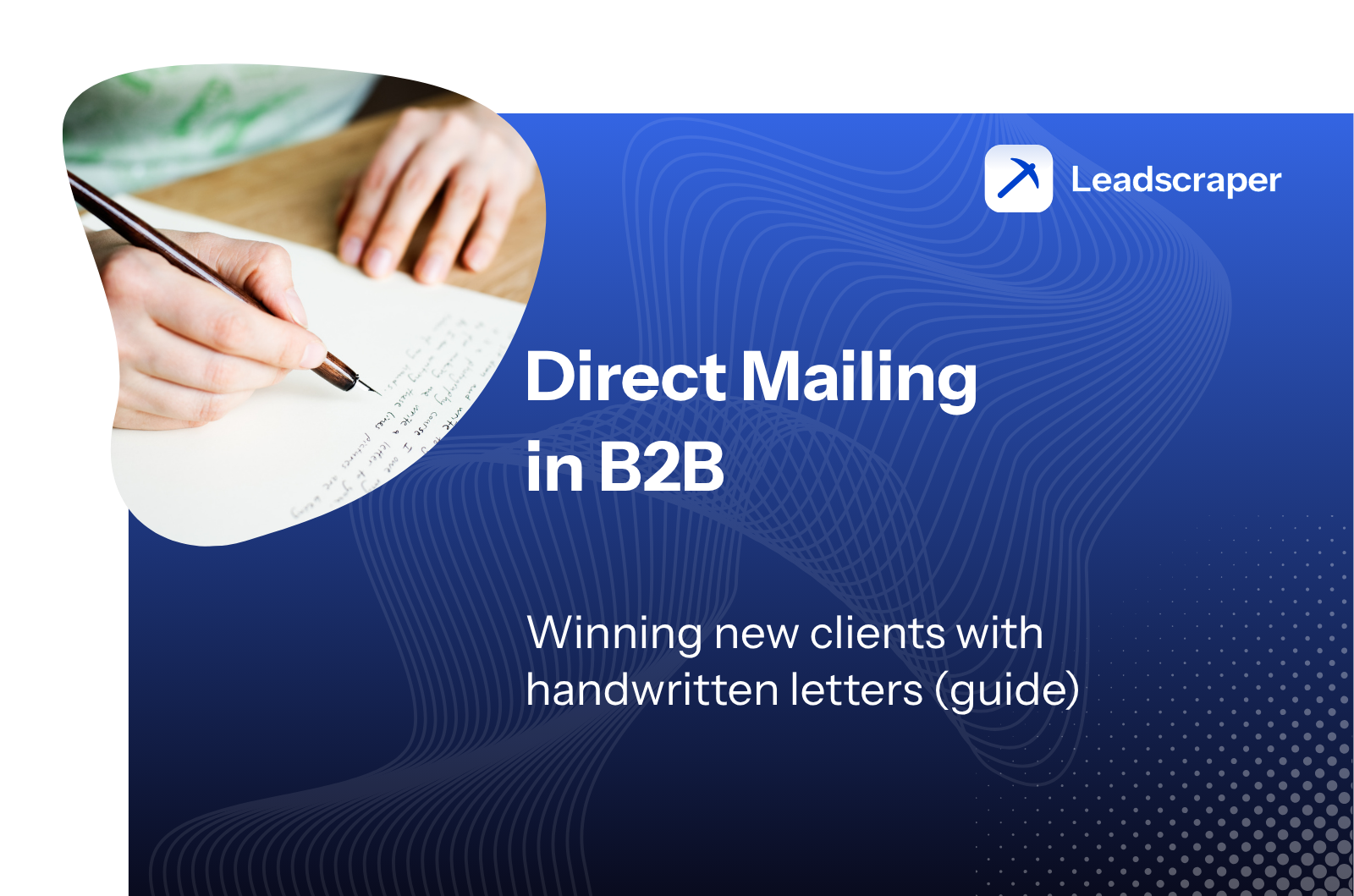
With a direct mailing you send advertising by post to one specific person, by name and with a personal salutation. In B2B that is the decision maker at the target company, the one you researched beforehand.
The terms get mixed up a lot, so here is the distinction. Direct marketing is the umbrella term for any direct, measurable approach to individual recipients on any channel. Dialogue marketing means the same thing with the emphasis on the response you want. Direct mailing is the postal part of it. Print mailing is usually used as a synonym.
For you in sales, one distinction matters most. Addressed items go to a known person, unaddressed leaflets go to every household in a region. Only the addressed version makes sense in B2B, because you want to reach one particular person inside the company.
Why post is working again in B2B
The channel benefits from every other one being crowded. A decision maker gets dozens of emails and several calls a day and rarely a personally addressed letter.
There is still room in the letterbox
Put the numbers side by side once. On a normal day maybe three items sit on the desk while hundreds of emails wait in the inbox. On top of that, a letter does not land in a spam filter and does not get swiped away after three seconds.
In a TEDx talk about handwritten letters, Will McDonough sums up an experience that holds just as true in B2B. When he asked whether he was allowed to write at all, the answer was that they receive a lot of post, so he should make the envelope look particularly good. The attention starts at the envelope, long before anyone reads the text.
What a letter cannot do
Most campaigns fail on the wrong expectation. A sales expert says in his video on omnichannel prospecting that direct mail is no magic potion. Nobody opens a letter, reaches for the phone and asks for a meeting.
The letter works differently. It gives you the hook for the call three days later. Instead of a cold opening you start with a reference the other person can place. Plan the letter as a self-runner and you burn money. Use it as a door opener for phone prospecting and it buys you a much better start to the conversation.
The legal position and why the letter follows different rules
Postal advertising to companies is allowed without prior consent as long as the recipient has not objected. That puts the letter in a far better legal position than cold email outreach, because that channel does need consent.
The ePrivacy rules and why letters sit outside them
Article 13 of the ePrivacy Directive 2002/58/EC sets out which marketing channels need prior consent across the EU. It names automated calling systems, fax machines and electronic mail. Postal advertising does not appear in that list. Every member state turns the directive into national law, Germany through § 7 (2) UWG, which repeats the same catalogue and again leaves letters out.
For a marketing email you need prior explicit consent, for a letter you do not. The general rules on unfair commercial practices still apply. Advertising becomes unlawful as soon as it runs against the recognisable will of the recipient, which in Germany follows from § 7 (1) UWG. Anyone who writes to you saying they want nothing further has to come off the list.
No consent required. Not listed in Article 13 of the ePrivacy Directive. An objection has to be honoured.
Consent required. Article 13 calls for prior explicit consent, in Germany implemented in § 7 (2) no. 2 UWG.
Consent required. Explicit consent for consumers, in B2B the national rules differ.
Higher Regional Court of Stuttgart, decision of 02.02.2024, case no. 2 U 63/22, a German court decision on the interpretation of the GDPR. This article does not replace legal advice.
GDPR Article 6(1)(f) and legitimate interest
Under data protection law, postal advertising rests on legitimate interest under Article 6(1)(f) GDPR. Recital 47 of the GDPR expressly names processing for direct marketing purposes as a possible case of a legitimate interest, and that wording applies in every member state.
A German court, the Higher Regional Court of Stuttgart, confirmed this line in a decision of 2 February 2024 (case no. 2 U 63/22). Sending personalised postal advertising is covered by Article 6(1)(f) GDPR and permitted without consent. The second part of the decision is the decisive one for new business. The court expressly held that an existing customer relationship is no precondition. The decision binds only German proceedings, though it interprets the GDPR itself, so the reasoning is a useful reference in other member states as well.
B2B gives you one more thing in your favour. Pure company data such as the company name, the business address and general contact details is no personal data. The GDPR applies from the moment you address a natural person.
What belongs in the mailing so it stays clean
Three things are worth respecting whatever the size of your campaign.
- A notice about the right to object. Under Article 21(2) GDPR the recipient can object to direct marketing at any time. One sentence at the end of the letter is enough.
- A traceable source for the data. You have to be able to say where the address came from when asked. Publicly accessible sources such as company websites, legal notices and trade directories are unproblematic.
- A properly maintained suppression list. Every objection gets documented and applied to the next wave. This matters under unfair competition law too, because rules like § 7 (1) UWG in Germany bite as soon as a contrary intention is apparent.
This section does not replace legal advice. For larger campaigns or purchased address lists, the short trip to your data protection officer is worth it.
The formats compared
Not every format suits every goal. Four variants are common in B2B prospecting.
| Format | When it fits | Effort | Effect |
|---|---|---|---|
| Postcard | Reactivation, event invitation, contacts who know you | Low | Gets seen, and gets read by third parties too. Too casual for a first approach |
| Standard letter | Classic first approach to a decision maker | Medium | Solid basis. The effect stands and falls with the envelope and the copy |
| Letter with brochure | Offers that need explaining, several decision makers | Medium | Stays on the desk and gets passed on, at the price of higher postage |
| Handwritten letter | Small, high value target groups with large deal sizes | High | Highest chance of being opened, clearly higher unit cost |
| Dimensional mail | Very narrow target list, strategically important accounts | Very high | A parcel almost always gets opened. Only pays off on large deals |
In my experience the standard letter is the right starting point for most B2B campaigns. It is cheap enough for a meaningful sample and good enough to be taken seriously.
The handwritten letter as the premium option
The handwritten letter is the most expensive and the most effective option. It pays off when your target list is small and a single closed deal is worth a lot.
You run that calculation through your contribution margin. If a won customer brings you 15.000 euros, it makes no difference whether the approach cost 1,50 euros or 6 euros per contact. At a deal value of 800 euros it looks different.
In practice a middle path works best. The letter comes out of the printer, the envelope is addressed by hand and a short handwritten line sits under the signature. Whether fully handwritten letters pay off or a writing robot is enough depends on your contribution margin per new customer and on the reason you have for writing.
The envelope decides whether the letter arrives at all
The envelope is the most underrated part, because in B2B the decision maker rarely opens the post. In a much discussed thread in the subreddit r/sales, a sales rep describes exactly this problem. The replies deliver concrete rules.
- No company logo on the envelope. Anything recognisable as advertising gets sorted out by the front office before anyone opens it.
- No address labels. A handwritten address reads like personal correspondence and gets passed through.
- A real stamp instead of a franking mark. Franked bulk items are recognisable as advertising straight away.
- Larger format with the letter unfolded. An unfolded letter in a large envelope signals value, though in Germany it costs 1,80 euros in postage as a large letter.
Source: discussion in r/sales
A practitioner in the same thread goes further and works with eye catching envelopes, for example coloured padded envelopes at around one dollar each. His argument is the follow-up call. He can say he is the one with the blue envelope. The other person remembers it. That even works on voicemail. He openly contradicts the standard advice from the sales classic "Selling to VITO", which says you are better off not mentioning the letter on the call.
What a B2B mailing costs
Unit costs run somewhere between 1,30 euros and 6 euros depending on the format. What counts in the end is what an appointment costs you.
The cost blocks
A B2B mailing is made up of four positions.
- Postage. In Germany the standard letter still costs 0,95 euros in 2026, the compact letter 1,10 euros and the large letter 1,80 euros, with the prices fixed until the end of 2026. Rates differ from country to country, so take the price list of your own postal operator as the basis.
- Print and material. Paper, envelope and printing come to roughly 0,30 to 0,60 euros per item, more with high quality paper.
- Handwriting or finishing. A writing service costs several euros per letter depending on the provider and the length of the text. That is the position that pushes your unit cost up the most.
- Address data. Either your own research time or a tool. This position gets underestimated almost every time, more on that in a moment.
There is one point where almost everyone miscalculates. The cheap Dialogpost rate from Deutsche Post starts at 0,38 euros net per item but requires a minimum volume of 5.000 items nationwide. A typical B2B mailing to 200 to 500 decision makers never reaches that threshold, so you calculate with the regular letter rate. Anyone who budgeted with Dialogpost prices is off by more than double. Postal operators in other countries run comparable bulk rates with their own volume thresholds, so check what applies in your market.
Cost per appointment instead of cost per item
Four steps get you to the number that actually says something. Total cost is volume times cost per item. The responses come from volume times response rate, the appointments from responses times appointment rate. At the end you divide total cost by appointments.
With the calculator you can run your own assumptions.
Move the sliders and watch how the cost per appointment changes.
A worked example with realistic assumptions. At 300 letters at 1,50 euros each the campaign costs 450 euros. At 3 percent response that is 9 reactions. If every third one leads to an appointment, you get 3 appointments. That works out at around 150 euros per appointment.
You can hold that number straight against your other channels. If an appointment through paid ads costs you 400 euros, the mailing is cheap. If cold calling on the phone gets you one for 60 euros, you need a good reason for sending letters.
The follow-up call belongs in the calculation as well. Send 300 letters and call every recipient and you invest several working days. That time costs you more in the end than the postage.
Which response rates are realistic
For cold B2B lists you should plan with 2 to 4 percent response. Anyone promising you double that is talking about existing customers.
The ANA/DMA Response Rate Report gives an average of 4,4 percent for 2025 while separating two list types. Your own existing customers come in at 5 to 9 percent, cold addresses at 2 to 4,4 percent. The second figure is the one that applies to new business. Anything above 4 percent is already strong there, and email sits at 0,12 percent for comparison.
Most articles on the topic quote 3,7 percent from a report published in 2017, again without that distinction. Build your budget on it and you are counting money you will never see.
So plan several waves instead of one single push. Recipients react once the need is there. Some get in touch after several waves saying they have just heard of you for the first time.
Why direct mail disappears in attribution
The channel also gets underrated because it is hard to measure. Print a dedicated phone number on the mailing and you will regularly hear callers say they googled the company, even though the number they dialled only ever appeared on the letter. The last touchpoint is what sticks in people's minds. Without a dedicated number, landing page or QR code you credit the success of your mailing to other channels. Keep your sales pipeline clean and the mailing contact gets recorded as its own source.
How the sequence of letter and call runs
The letter is only one of five steps. Without the rest it stays an expensive piece of post.
Check the data
Is the contact person still right, is the address still right. A list that was perfect six months ago is out of date today. Every item sent to someone who has left the company is money gone.
Letter goes out
Time the dispatch so the item arrives Tuesday to Thursday. On Monday the letter competes with the weekend pile, on Friday nobody reads it any more.
Follow-up call
The actual appointment step. You call and refer directly to the letter. The difference to a cold call is considerable, because you do not have to invent a pretext.
Second attempt
If you reach nobody, try a different time of day or go through the switchboard. A marketing email is tricky here, because Article 13 of the ePrivacy Directive calls for consent that the letter does not give you.
Stay on it
Keep following up until you reach the decision maker. Most campaigns die after the first attempt.
Template for the follow-up call opener
The question about the letter works even when it never arrived. It buys you the permission to keep talking. That is what the first twenty seconds are about.
Where the addresses come from
Data quality decides the campaign, because every mistake here costs money directly. With an email a wrong address is annoying, with a letter you pay for every failed attempt.
Without a name the letter does not arrive
A letter addressed to "Management" lands in the mail room and from there in the bin. You need the name of the person who decides on your topic, plus their role in the company.
For B2B prospecting, researching the right contact person is therefore the most time consuming part of the preparation. You can hand that research to a tool as well. Leadscraper pulls company data, contact people and phone numbers together from publicly accessible sources. The advantage for a mailing is that you get the address and the phone number out of the same research and can make the follow-up call without a second research round.
Data ages faster than most people expect
Contact people change roles, companies move or rename themselves. Every list therefore gets less accurate from the day you built it. Reuse a list from last year and a substantial share of your volume goes nowhere.
Building a clean target list is worth a structured approach, along the lines described for creating a B2B lead list. As a rule of thumb the data should be no older than four to six weeks at the time of dispatch.
What belongs in the letter
A B2B prospecting letter is short. One page, six to eight paragraphs. Everything else belongs in the enclosure.
The structure from subject line to PS
- Subject line. Concrete and free of marketing language. It names the recipient's topic, and your product has no place here.
- Salutation. By name and spelled correctly. A wrong title costs you the rest of the letter.
- Opening. The first sentence belongs to the recipient. A concrete reference to their company shows the letter did not go to a thousand addresses.
- Main part. One problem, one solution, one piece of evidence. Nothing more fits on a page and nobody reads more either.
- Call to action. One single small action. A short conversation at a concrete time is entirely enough.
- Signature. By hand, with a blue pen. It costs nothing and works immediately.
- PS. The second most read element after the salutation. Put the core benefit here once more in a single sentence.
Template for a B2B prospecting letter
The sentence announcing the call is the most important one in the whole letter. When you then call, you are only keeping what you announced.
Template for a handwritten card
The premium option follows a different format. One card, four to five sentences, no advertising material in the envelope.
For the handwritten version the practical advice is clear. No brochures, no business card, no flyer. As soon as advertising material sits in the envelope, the item loses its personal character.
Checklist before dispatch
What you enclose
Whether anything goes into the envelope at all depends on which version you run. With a handwritten letter the envelope stays empty, because the whole effect rests on the item looking like private post. As soon as a brochure sits next to it, that impression is gone.
With a classic company mailing it is the other way round. Here you identify yourself as a company anyway. The enclosure then carries the actual content and the letter becomes the cover note that explains why the whole thing is on the desk.
What belongs in the brochure
Four building blocks are enough for a first B2B contact.
- Case studies with numbers. Two or three examples from the recipient's industry, each with the starting position, the approach and a measurable result. That is the part people really read.
- References with names. Logos on their own convince nobody. A quote with name, position and company works far better, provided you have the approval for it.
- A short introduction. Who you are, how long you have been around, who you work for. Half a page is enough.
- One concrete offer. The reason someone reaches for the phone after reading.
Four to eight pages is the right length. At 24 pages the brochure ends up unread in the filing pile.
Why the enclosure often pays off in B2B
The letter itself usually goes in the bin after reading. A brochure stays on the desk and gets passed on. In B2B a single person rarely decides alone. The printed document is then what lies on the table in the next meeting.
You pay for that through postage and printing. In Germany the standard letter at 0,95 euros covers up to 20 grams, so around three sheets. With a brochure you end up at the compact letter for 1,10 euros or the large letter for 1,80 euros. On top come the printing costs, which are noticeably higher per unit on small runs. In other countries the weight steps and the prices differ, so check the tariff of your own operator.
In my view the enclosure is worth it from the point where your offer needs explaining or several people decide together. For a simple service with a clear price the letter on its own is enough.
Common mistakes
!Letter to the company instead of a person
Without a name the mail room decides whether your letter reaches anybody.
!Nothing happens after dispatch
The most common and most expensive mistake. Without the follow-up call you give away the largest part of the effect.
!An enclosure in a personal letter
Open the letter like private post and then add a brochure, and you cancel out the effect yourself.
!Too large a volume on the first attempt
Test with 50 to 100 items before you send 1.000.
!No tracking built in
Without a dedicated phone number or QR code you have no way of knowing afterwards whether the campaign worked.
!Budgeting with bulk mail prices
The minimum volume of 5.000 items puts the German Dialogpost rate out of reach for most B2B campaigns, and other countries apply similar thresholds.
!A one off action instead of a series
Stop after one wave and you break off before the effect even starts.
Who direct mailing pays off for and who it does not
The channel fits if …
- your average order value is four figures or higher
- the target group is clearly definable and manageable in size
- the decision makers are hard to reach digitally
- you sell into industry, trades, construction supply or medical technology
The channel does not fit if …
- you serve a broad market with low order values
- your sales cycles are very short
- the target group is easy to reach by email and LinkedIn anyway
- you cannot plan any capacity for the follow-up call
Where email and phone never reach the decision maker, the letter brings you conversations that would otherwise never have happened. As a replacement for the digital channels it still does not work.
Conclusion
Direct mailing remains a niche channel. For broad target groups with small order values it does not add up, because postage and manual work are too expensive for that.
In my view those very costs are the reason the channel is working again right now. Email and LinkedIn messages cost practically nothing, so they arrive in bulk. AI generated sequences are making that worse. A letter cannot be sent in those quantities. That effort is the actual signal for the recipient.
The legal position is a big advantage. Postal advertising to companies is allowed without consent, while the same message by email needs an opt in. Very few sales teams have that on their radar. Nothing about the legal position is likely to change quickly.
If you want to test the channel, take your 50 most important target accounts. Research the contact people properly, write the letters in one afternoon and block the follow-up calls in your calendar right away. The bottleneck in the end is the time for the phone.
Whether you carry on is then decided by a single number. If your cost per appointment sits below that of your existing channels, you scale up. If it sits above, you have answered a question for a few hundred euros that would otherwise have stayed open.
The classic sales letter is one of the most effective forms of direct mail. How to structure it, phrase it well and put it to work with ready-made templates is covered in the guide on writing a sales letter.
Direct mail works best alongside other channels. For a comparison of every route and the cost per lead, see the guide to B2B direct marketing.
Frequently asked questions about direct mailing in B2B
Is postal advertising to companies allowed without consent?
Yes. Article 13 of the ePrivacy Directive 2002/58/EC lists automated calls, fax and electronic mail as channels that need prior consent, and postal advertising is not among them. Germany implements this in § 7 (2) UWG with the same result. Under data protection law the mailing rests on legitimate interest under Article 6(1)(f) GDPR. The Higher Regional Court of Stuttgart, a German court, confirmed this in a decision of 2 February 2024 (case no. 2 U 63/22) and expressly held that no existing customer relationship is required. If a recipient objects, they have to come off the list.
What response rate is realistic for a B2B mailing?
On cold address lists 2 to 4 percent is realistic. The ANA/DMA Response Rate Report 2025 gives a range of 2 to 4,4 percent for prospect lists and 5 to 9 percent for existing customer lists. Higher figures in trade articles almost always refer to existing customers.
What does a B2B mailing cost per letter?
A simple standard letter in Germany comes to around 1,25 to 1,55 euros, made up of 0,95 euros postage plus print and material. Handwritten versions with a writing service run to several euros per item. The cheap Dialogpost rate from 0,38 euros net requires a minimum volume of 5.000 items and is therefore out of reach for most B2B campaigns. Postage differs in every country, so use the price list of your own operator.
How many letters do I have to send for it to be worth it?
For a first test 50 to 100 items are enough to check the mechanics. For statistically meaningful statements about the response rate you need several hundred. Repetition matters more than volume, because recipients usually react only once the need appears.
Is a handwritten letter worth it compared with a printed one?
For small target groups with a high order value yes, for large volumes rarely. A good compromise is a printed letter with a handwritten address on the envelope, a real stamp and one handwritten line under the signature. That gets you the largest part of the effect at a fraction of the cost.
Should I enclose a brochure?
With a handwritten letter no, because the item then looks like advertising. With a classic company mailing it is worth it as soon as your offer needs explaining or several people decide together. Four to eight pages with case studies and references are enough. Expect the item to get heavier, which in Germany moves you from 0,95 euros to 1,10 euros for the compact letter or 1,80 euros for the large letter.
When do I call after dispatch?
Three to five days after dispatch. Earlier and the letter may not have been read yet, later and it is forgotten. Announce the call in the letter with a weekday and a time, then the call is an announcement you are keeping.
How do I measure whether my mailing worked?
Through a dedicated phone number, a dedicated landing page or a QR code that appear on the mailing and nowhere else. Without that marker, recipients later credit their contact to other channels, because only the last touchpoint stays in their mind.
Where do I get the addresses for a B2B mailing?
From publicly accessible sources such as company websites, legal notices and trade directories, either through your own research or through a tool for lead research. Leadscraper puts the company address, the contact person and the phone number together in one pass. That is practical for a mailing, because you get the number for the follow-up call without a second research round. What matters in every case is a named contact person with their role, because a letter addressed to the management in general ends in the mail room. Make sure the data is no older than four to six weeks when you send.
%20(7).jpeg)