
.svg)
.svg)
B2B Direct Marketing: Channels, Costs and What Actually Works in 2026

Generate B2B Leads with AI?
With LeadScraper, you create suitable B2B lists in seconds. 100% GDPR compliant. No subscription required!
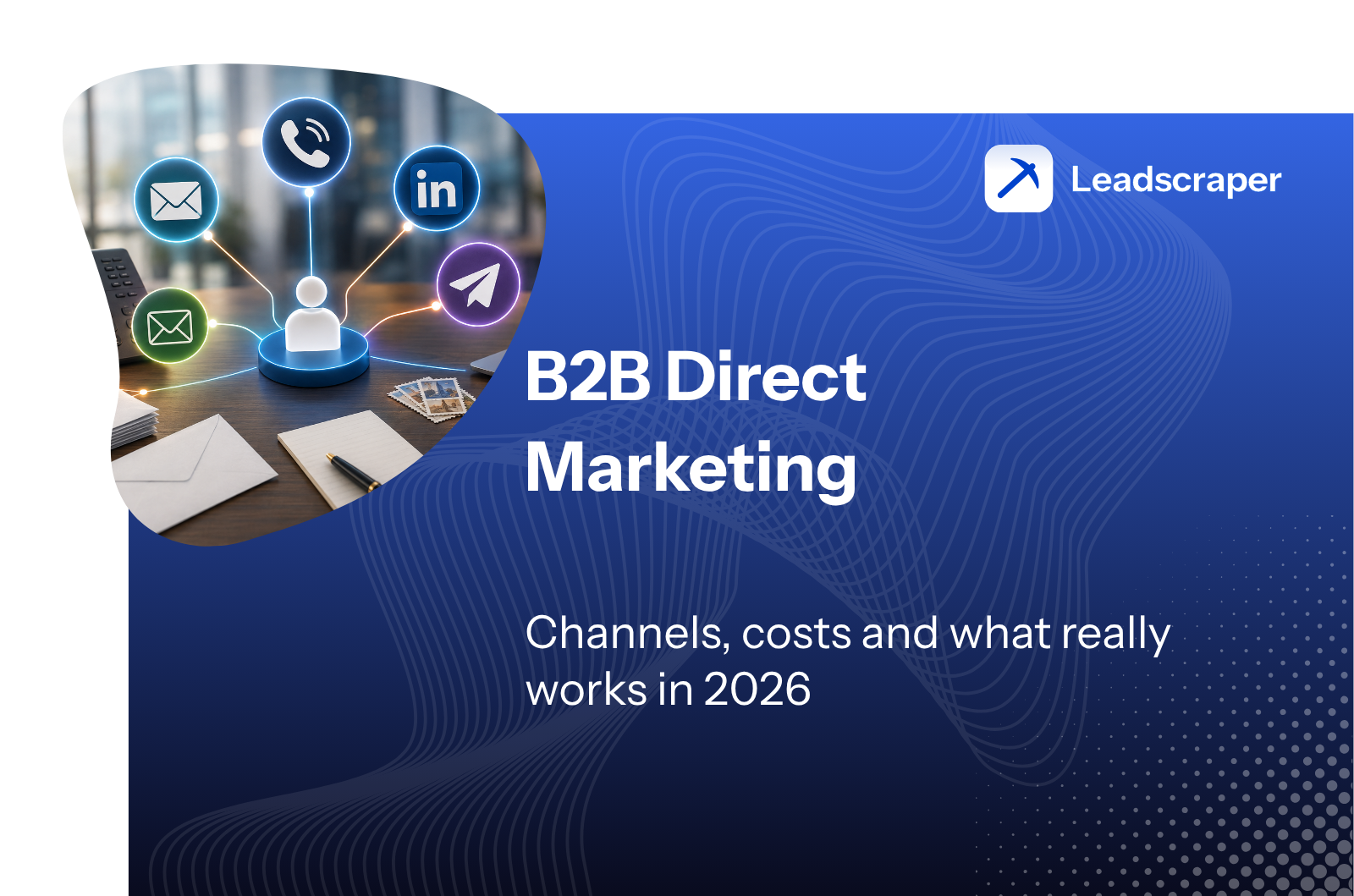
CREATE TEST ACCOUNTIf you want to win new B2B customers, 2026 gives you more channels to choose from than ever: phone, email, LinkedIn, direct mail, messaging. B2B direct marketing pulls exactly these channels together under one idea. Instead of broadcasting and hoping, it opens a genuine reply channel that lets the recipient respond directly. The difference sounds small, but it decides whether your marketing budget turns into measurable conversations.
This guide explains what B2B direct marketing means, which channels belong to it, roughly what each channel costs, what actually works in 2026 according to the latest numbers and what is legally allowed.
- Direct marketing means outreach with a reply channel. The recipient can respond directly instead of just being talked at. In B2B, this is the path from mere visibility to a concrete conversation.
- The most important channels are phone, email, LinkedIn, direct mail and the handwritten letter. Each has its own costs, strengths and legal rules.
- Calculate per lead, not per contact. A cheap channel with a weak response rate often ends up more expensive than a costly channel with high attention.
- What works in 2026: several channels combined rather than a single channel, warm contacts rather than cold ones and a researched reason to reach out rather than mass outreach.
- Legally, postal mail is the simplest channel in B2B. Email and automated calls require prior consent under the EU ePrivacy Directive, while live phone calls depend on each member state's national rules.
What is B2B direct marketing?
Direct marketing is any form of advertising that aims for a direct response from the recipient and offers a reply channel for it. The recipient is meant to take in the message and react to it, with a callback, a reply email or a booked meeting. Unlike classic one-way advertising such as an ad or a billboard, the communication runs in both directions and can be measured per contact.
Classic advertising
Ad, billboard, radio: one message to many, without a reply channel. Broad reach, but barely measurable and with no direct route to an individual's response.
Direct marketing
Targeted, often personal outreach with a clear call to action and a reply channel. Every response is measurable and can be attributed to a contact.
The terms direct marketing and direct response marketing often get used interchangeably. Direct marketing means addressable, one-to-one outreach to a single recipient. Direct response marketing puts extra emphasis on the two-way nature, the planned reply channel and the continued exchange. In B2B the two effectively merge, because almost every approach here leads to a conversation with a specific contact person.
The instruments of B2B direct marketing include cold calling, email outreach, direct mail and letters, messaging and LinkedIn as well as response elements on your own website. The common thread is always the same: a clear addressee, a relevant message and an easy way to respond.
The channels at a glance in 2026
Each channel has its own profile of cost, attention and legal status. The overview below sorts the five most important B2B marketing channels. The cost per contact figures are rough orders of magnitude and depend heavily on volume, target audience and execution.
| Channel | Cost per contact | Strength | Legal status in B2B |
|---|---|---|---|
| Phone | High (time per call) | Direct dialogue, instant feedback, a meeting booked in the same call | Depends on national rules (opt-in or opt-out) |
| Very low (cents) | Quickly scalable, measurable, directly linkable | Prior consent required (strict) | |
| Medium (time plus tool) | Context on the person, relationship building, high response rate | Grey area, treat like email | |
| Direct mail | Low single-digit euros | Lands physically on the desk, little competition | Allowed without consent |
| Handwritten letter | Higher per piece | Highest attention, feels personal rather than mass-produced | Allowed without consent |
In detail, each channel plays to its strength in a different situation.
Phone
The phone delivers the most immediate dialogue. A good call clarifies needs, objections and the next step in a few minutes. The price for that is the high time investment per contact and difficult reachability. For a structured way to approach cold calling in 2026, see the guide on cold calling. For handling typical rejections, the article on objection handling helps.
Email is the cheapest and fastest-scaling channel. Its weakness is the crowded inbox, where generic messages get lost. What matters is a researched hook and a clean data foundation. For how to build cold emails that get opened and answered, see the guide on cold email outreach. Where the right addresses come from is covered in the article on finding email addresses.
LinkedIn and social selling
LinkedIn combines reach with context. Combining your profile, posts and a personal message builds a relationship before you sell anything. Response rates sit noticeably above classic email, but the channel is more time-consuming and harder to automate without coming across as impersonal.
Direct mail and letters
Physical mail reaches decision-makers where there is barely any competition left: the mailbox. A personally worded letter gets read where a mass email gets deleted. Postage, formats and response rates are covered in depth in the guide on B2B direct mail. How an effective letter is built line by line is shown in the article on writing a sales letter.
The handwritten letter
The handwritten letter plays a special role. Real handwriting stands out immediately from any printed advertising mailer and signals personal attention rather than a form letter. The recipient gets the impression that someone really took the time. That is exactly what raises the chance the letter gets read and answered. By hand this effect barely scales, but automated with a writing robot it does.
What actually works in 2026
Channels are one thing, how they work together is another. Four patterns run through the latest numbers and separate successful campaigns from expensive wasted spend.
Several channels instead of one
Campaigns across three or more channels achieve a markedly higher purchase rate than single-channel approaches. Phone, email and LinkedIn combined beat any channel on its own.
Warm contacts instead of cold
Knowing the recipient and their needs before reaching out means fewer contact attempts and no burned first contacts. Warming up through content and LinkedIn pays off.
A reason instead of mass outreach
A researched trigger in the first sentence decides between reading and deleting. Signal-based outreach hits the right moment instead of blindly working through a list.
Tangibility raises the response rate
Physical mail and especially the handwritten letter stand out from the digital noise. Where the inbox overflows, the channel with the highest attention wins.
The numbers behind this are clear. A compilation of multichannel benchmarks cites Omnisend data showing that campaigns with three or more channels achieve a 287% higher purchase rate than single-channel campaigns. In the same channel comparison, LinkedIn messages reach around a 10.3% response rate, roughly double the 5.1% for cold emails. The comparison is even clearer for physical mail. An analysis of the ANA Response Rate Report puts direct mail at a 4.4% response rate, against 0.12% for email. The two email figures come from different studies with different measurement methods and therefore do not work as a direct comparison with each other. The analyses are also international, but the pattern shows up in B2B across Europe too.
The common thread behind all four patterns is the preparation. Knowing the right companies, the right contact person and a genuine reason lets you play every channel warmer and cheaper. How to find such triggers systematically is shown in the guide on trigger events.
A single touchpoint is rarely enough. What works is a planned sequence across several channels, for example a letter as a door opener, then a fitting email and a call that refers back to the letter. Each step picks up the previous one instead of starting from scratch. This raises the response rate without you needing more contacts.
What B2B direct marketing costs
The decisive figure is the cost per lead. The plain cost per contact easily misleads. An email contact costing a few cents with a weak response rate can end up more expensive than a letter costing several euros with high attention. Only when you calculate cost per contact, response rate and qualification together do the channels become comparable.
That is exactly what you can play through. Enter the values for one channel and compare the result with a second channel.
An example for the first tab: a direct mail piece costs you €3 per send, 5% of recipients respond and 40% of those responses become a real lead. That puts a qualified lead at €150. An email at 20 cents with a 1% response rate and the same qualification lands at €50 per lead. If the response rate drops on the letter or rises on the email, the picture flips. This calculation decides the channel choice rather than the plain unit price. The second tab carries the funnel through to the close. How to set up cost per lead cleanly is covered in the article on calculating cost per lead.
In-house, agency or software?
There are three ways to run this. They differ mainly in how much work stays with you and how the costs arise.
| Approach | What you get | Your effort | Cost logic |
|---|---|---|---|
| Leadscraper / Autopilot | Research of matching companies, contacts and first contact from a single source | Low, you run the conversations | Credit-based |
| Your own team | Full control and closeness to your offering | High: setup, tools, management | Salaries plus tools |
| Direct marketing agency | External execution with campaign experience | Medium: briefing and management | Retainer or per project |
An in-house team pays off once the volume is permanently high and the offering needs explaining. An agency takes the execution off your hands, but needs a clear briefing and ongoing management. One thing matters here: as soon as you hand personal contact data to an agency or service provider, they process it on your behalf. That makes a data processing agreement under Article 28 GDPR mandatory. The comparison with classic outsourcing is covered in depth in the guide on the external cold calling agency and the article on outsourcing sales.
The third way starts one step earlier. For the research part, many rely on Leadscraper. Instead of rigid filter lists, the tool searches the web in real time via a free-text prompt and decides for each hit whether a business fits your offering. Every customer builds up their own context through their feedback, so the results get more accurate over time. The companies found are enriched with context, namely the very triggers and contacts that make a good hook. Billing is credit-based.
Beyond pure research, Leadscraper covers the entire path, from identifying suitable companies through the right contact person to the first approach. If you would rather not take this step yourself, you can hand it over as a managed service with Leadscraper Autopilot. Here Leadscraper takes over the research and sends the outreach as a real, handwritten letter. In the end, only the conversations and the close stay with you.
Law and GDPR in B2B direct marketing
The channels are regulated with differing strictness. Applying the rules of one channel to another risks a complaint or fine. In advertising law, the key framework across the EU is the ePrivacy Directive.
- Phone: A live marketing call in B2B depends on national implementation. Some member states require prior opt-in, others allow an opt-out approach where there is a factual link between your offering and the person called.
- Email: Marketing emails generally require the recipient's prior consent. The EU ePrivacy Directive names email explicitly as a channel that needs opt-in for unsolicited commercial messages.
- Fax and automated systems: Automated calling systems and fax also require prior consent under the ePrivacy Directive.
- Postal letter: The classic letter does not appear in this list. It falls outside ePrivacy and is generally permitted under legitimate interest, until repeated approaches against the recipient's evident wishes make it unlawful.
For letters, data protection does not stand in the way of personalised advertising either. Under Article 6(1)(f) GDPR, direct marketing by post can be based on legitimate interest, and Recital 47 names direct marketing explicitly as a legitimate interest. That means personalised letter advertising is generally permitted without explicit consent. The recipient can object to the advertising at any time, after which further outreach must stop. And the addresses have to be obtained lawfully. This section is a general overview and not legal advice.
Common mistakes in direct marketing
Most campaigns fail on avoidable planning mistakes, rarely on budget. These four come up most often.
Everything on one channel
Only emailing or only calling gives away reach and response rate. A single touchpoint is rarely enough for a reaction in B2B.
Mass outreach with no reason
A generic text to a bought list reads like a flyer. Without a researched connection, there is no reason to respond right now.
Only looking at the unit price
The cheapest channel per contact is not the cheapest per lead. Ignoring the response rate often means picking the most expensive route to a meeting.
Mixing up the legal rules
The easy letter rules do not apply to calls and email. Emailing or calling without consent risks a complaint or fine.
Conclusion
B2B direct marketing wins in 2026 where channels are combined and thought through from the recipient's side. Phone, email, LinkedIn and letters each play to their strength in a different situation, and they only become truly effective in a planned sequence. Always calculate per lead and not per contact, and the cheapest unit price will not mislead you.
The channel choice is ultimately decided by the preparation. A researched reason, the right company and the right contact person make every channel warmer, cheaper and cleaner in legal terms. Investing in this research first and playing the channels afterwards turns your marketing budget into reliable conversations. This is exactly where Leadscraper comes in, from research to a warm first contact.
Frequently asked questions about B2B direct marketing
What is B2B direct marketing?
B2B direct marketing is any advertising that aims for a direct response and offers a reply channel for it. In B2B, that means targeted, often personal outreach by phone, email, LinkedIn or letter, meant to move the recipient toward a callback, a reply or a meeting. Unlike classic one-way advertising, every reaction is measurable and can be attributed to a contact.
Which channels belong to direct marketing?
The most important B2B marketing channels are the phone, email, LinkedIn and social selling, direct mail and the handwritten letter. On top of that come messaging and response elements on your own website. Each channel has its own costs, strengths and legal rules, and they work best in a planned combination.
What does B2B direct marketing cost?
It depends on the channel. An email costs a few cents per contact, direct mail sits in the low single-digit euros per send, a call is expensive over time. The meaningful figure, though, is the cost per lead, that is cost per contact divided by response rate and qualification. A cheap channel with a weak response rate can be more expensive per lead than a costly channel with high attention.
Which channel works best in 2026?
The combination of several channels works best. According to the analyses, campaigns across three or more channels achieve a markedly higher purchase rate than single-channel approaches. LinkedIn scores with a high response rate, email with speed and scale, the letter with attention. What matters is playing the channels in a sequence with a researched reason to reach out.
Is B2B direct marketing GDPR-compliant?
It depends on the channel. Personalised letter advertising is generally permitted without consent based on legitimate interest under Article 6(1)(f) GDPR, with Recital 47 naming direct marketing explicitly. Marketing emails and automated calls, by contrast, require prior consent under the EU ePrivacy Directive, while live B2B phone calls depend on national implementation in each member state. As soon as you hand contact data to a service provider, you also need a data processing agreement under Article 28 GDPR.
%2520(7).jpeg)