
.svg)
.svg)
Account Based Marketing: Strategy, Models, and Implementation in B2B
%2520(7).jpeg)
Generate B2B Leads with AI?
With LeadScraper, you create suitable B2B lists in seconds. 100% GDPR compliant. No subscription required!
CREATE TEST ACCOUNTAccount Based Marketing flips traditional lead generation on its head. Instead of reaching out to as many contacts as possible and then filtering them, you start with a short list of high-value target accounts and engage with them in a focused manner. That sounds like more effort. And it is. But according to an analysis of over 800 B2B companies ABM delivers a higher ROI than any other marketing strategy.
- ABM focuses your budget on selected target accounts instead of broad audiences
- Three models: one-to-one (1 to 10 accounts), one-to-few (up to 50) and one-to-many (up to 1,000)
- What matters: a clean data foundation, sales and marketing alignment and a clearly defined Ideal Customer Profile
What is Account Based Marketing?
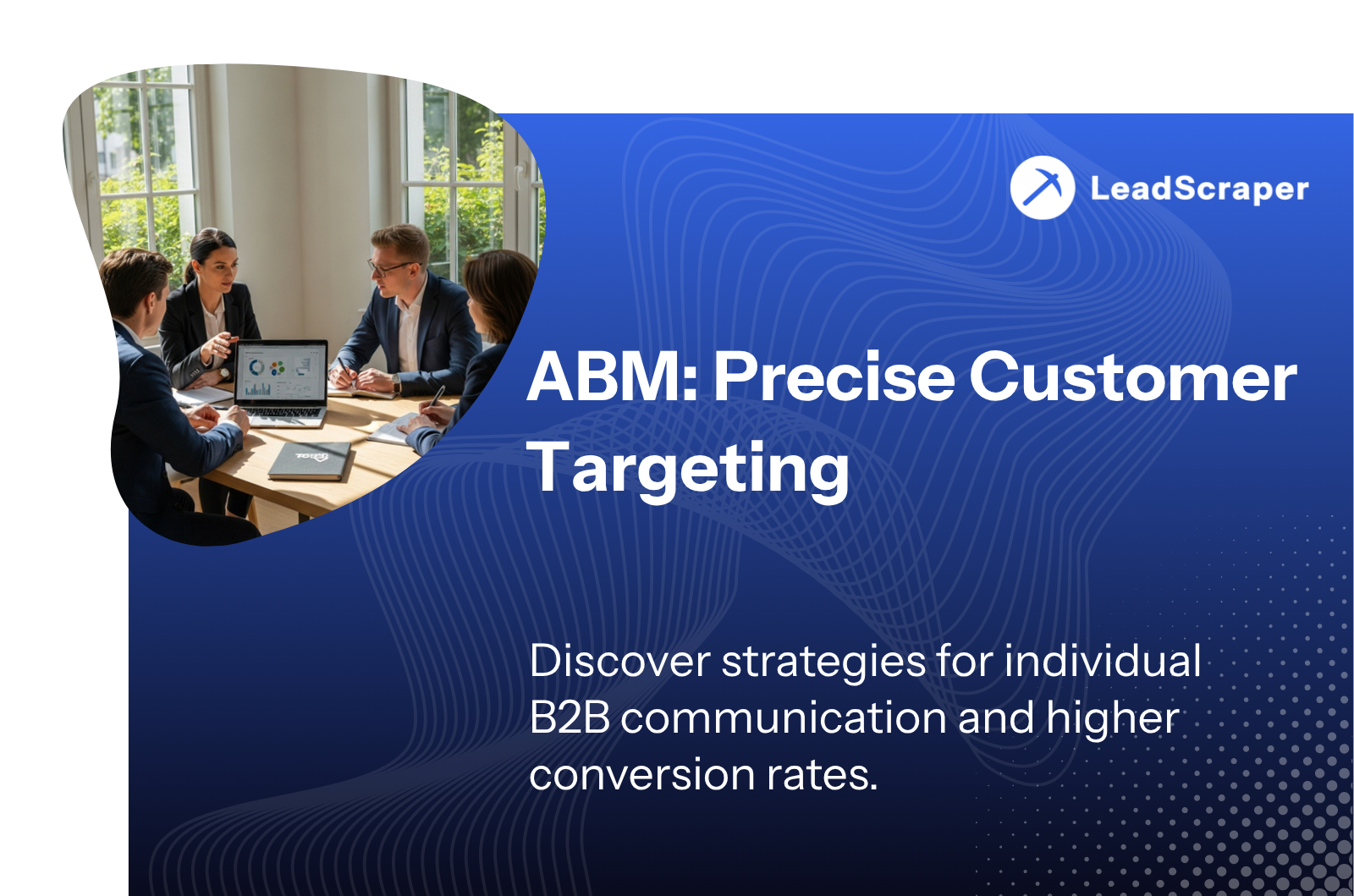
Account Based Marketing (ABM) is a strategic B2B approach where you specifically define individual companies as target accounts and engage with each of these accounts using individually tailored strategies. No spray-and-pray approach, no hoping for inbound leads. You know beforehand who you want to address, understand their decision-making structures, and develop content that precisely fits that specific account.
The term often appears synonymously with account-based selling. ABM originated in marketing, Account Based Selling (ABS) in sales. In practice, both approaches converge, because without close alignment between sales and marketing, ABM simply doesn't work.
The three ABM models at a glance
Not all ABM is created equal. Which model fits best primarily depends on the average deal value and available resources.
| Modell | Accounts | Aufwand | Geeignet für |
|---|---|---|---|
| Strategic ABM (One-to-One) | 1–10 | Sehr hoch | Enterprise-Deals, Key Accounts |
| ABM Lite (One-to-Few) | 10–50 | Mittel | Mittelständische Zielkunden |
| Programmatic ABM (One-to-Many) | 50–1.000 | Niedrig bis mittel | Skalierbare Kampagnen |
For most mid-sized B2B companies, ABM Lite is a good starting point. Strategic ABM is worthwhile for true key accounts. Programmatic ABM is only viable once automation tools are in use.
Why ABM is more effective than traditional marketing
ABM minimizes wasted resources because you only allocate resources to accounts where a genuine need is likely. In traditional outbound, you target broad audiences with campaigns, and a portion of them are never ready to buy. These losses accumulate over quarters.
According to the State of ABM Report 2025 companies with active ABM programs report an average of 28% shorter sales cycles. Stakeholders receive relevant content from the very first contact and don't have to be guided through generic nurturing sequences.
My take: Most B2B teams who consider ABM too resource-intensive haven't yet taken the step to clearly define their Ideal Customer Profile (ICP). Once the target customer profile is established, the operational effort is significantly reduced.
ABM Strategy in 5 Steps
Building an ABM strategy is not a sprint. The foundation determines whether the initiatives take hold or fall flat.
1. Define Ideal Customer Profile
Before you approach a single account, you need a clear picture of which companies are relevant. The more specific your Ideal Customer Profile, the more accurately you can derive the target list.
2. Identify and Prioritize Target Accounts
With a defined ICP, you can actively research accounts. A structured Lead Scoring, which evaluates accounts based on potential and likelihood to close, is helpful. Tools like LeadScraper help find suitable companies by industry, size, or region.
3. Understand Decision-Making Structures
In B2B deals, individuals are rarely the sole decision-makers. You're dealing with a buying center, multiple roles with different interests. If you don't understand these roles, you'll craft messages that only reach a portion of the buying center.
4. Develop Personalized Content
Often, customized email templates, an account-specific landing page, or a Case Study with a comparable reference customer are sufficient. The content must demonstrate that you understand the company's situation.
5. Coordinate Multichannel Engagement
ABM works best when multiple channels are leveraged in a coordinated way. LinkedIn is effective for reaching decision-makers with your content. The key is not to use as many channels as possible, but the right ones for each specific account.
Buying Signals: Identifying the Right Moment
Intent data helps identify when a target account is actively researching solutions in your area. These can be signals such as a new job posting, a LinkedIn post, or increased activity on your website. Anyone who systematically analyzes buying signals, refines their outreach timing significantly and noticeably improves response rates.
Tools for Account Based Marketing
ABM requires a foundation of data and automation. Without the right tools, personalization cannot be scaled effectively.
- Data Providers and Prospecting Tools: LeadScraper is effective in the DACH market for finding companies by industry, size, and region.
- CRM Systems: HubSpot, Salesforce, or Pipedrive provide the backbone for account tracking.
- ABM Platforms: Demandbase and Terminus offer features for account targeting and intent data.
- LinkedIn Sales Navigator: Essential for identifying decision-makers within target accounts.
Common Pitfalls in ABM Implementation
ABM typically fails in execution, not in strategy.
- Too many accounts at once: Better to engage deeply with 20 accounts than superficially with 200.
- Poor data quality: The quality of your input data directly impacts the quality of your campaigns.
- Sales and Marketing misalignment: In my experience, a lack of coordination is the most common reason why ABM initiatives quietly fizzle out after three months.
- Too generic content: Effective ABM content addresses the specific situation of each account.
- No clear definition of success: Pipeline development, engagement rate, and deal value are the relevant KPIs, not click-through rates.
Conclusion
Account Based Marketing works if you're willing to invest more deeply with less breadth. Fewer accounts, more relevance, higher close rates.
Define your ICP, build a target list of 20 to 30 accounts, and start consistently engaging with them. Clean data, a coordinated sales and marketing team, and focused discipline: Anyone who has all three will benefit from ABM, whether in mid-sized companies or the enterprise segment.
What is the difference between ABM and traditional lead generation?
Traditional lead generation aims to attract as many contacts as possible and then filter out the best ones. ABM reverses this: You first define which companies you want to acquire, and then align all efforts specifically towards those accounts. The result is fewer, but significantly higher-quality opportunities.
Which companies is ABM suitable for?
ABM is worthwhile for B2B companies with long sales cycles, high deal values, and a clearly definable target audience. Those who close deals over 10,000 Euros and interact with multiple decision-makers benefit the most. For transactional products with many small deals, the effort is usually not justified.
How many accounts should an ABM target list include?
With Strategic ABM, you work with 1 to 10 accounts simultaneously. ABM Lite works well with 10 to 50 accounts. Programmatic ABM can include several hundred accounts, but requires appropriate automation. It's better to have fewer accounts that you truly know than many that you only approach generically.
How do I measure the success of an ABM campaign?
Relevant metrics include account-level engagement rate, opportunity pipeline development, conversion rate to active deals, and average deal value. Traditional metrics like click-through rate are rarely meaningful in ABM.
How long does it take for ABM to show initial results?
The first measurable signs appear after 6 to 8 weeks. Real pipeline impact is noticeable after 3 to 6 months. ABM is not a short-term lever. Those who need quick leads should simultaneously pursue an outbound approach .