
.svg)
.svg)
Making Lead Generation GDPR-Compliant: Here's How It Works
%2520(7).jpeg)
Generate B2B Leads with AI?
With LeadScraper, you create suitable B2B lists in seconds. 100% GDPR compliant. No subscription required!
CREATE TEST ACCOUNTB2B sales can't succeed without fresh, qualified contacts, no matter how good the product is.
At the same time, the General Data Protection Regulation (GDPR) has ensured since 2018 that personal data can no longer be collected, stored, and used at will.
For many sales teams, this feels like a contradiction: On the one hand, they're supposed to acquire new customers, but on the other, legal pitfalls lurk around every corner. The good news? GDPR-compliant lead generation works. It just requires a different approach than indiscriminately buying contact lists. And those who do it right not only gain legal certainty but also noticeably better leads.
This article shows you step-by-step which rules apply, which mistakes you should avoid, and how modern tools can take over the work without violating data protection.
- The GDPR protects the personal data of contact persons in the B2B environment as well. Anyone generating leads always needs a documented legal basis for it, such as consent or a legitimate interest.
- Purchased lead lists, pre-checked boxes, and missing deletion periods are among the most common GDPR violations in sales and can result in substantial fines.
- Publicly accessible business data from company websites, directories, or commercial registers can be used in a GDPR-compliant way for lead generation. AI-powered tools like LeadScraper.de automate exactly this process and deliver fresh contacts in real time.
What does GDPR mean for B2B lead generation?
A common misconception stubbornly persists: “GDPR doesn't really apply in B2B.” That's not entirely true. While the business relationship is with a company, behind every email address, every phone call, and every business card is an identifiable person. And it is precisely this personal data that GDPR protects.
What does this mean specifically for your sales team? Three principles are particularly relevant:
Data Minimization: You may only collect the data you actually need for the specific purpose. A contact form that requests a date of birth and private address in addition to an email address, even though you're only sending a newsletter, violates this principle.
Purpose Limitation: The collected data may only be used for the purpose for which it was gathered. Someone who registers for a whitepaper has not automatically consented to receive promotional emails.
Transparency: Individuals have the right to know what data you store about them, where it originated, and how you use it. An up-to-date, clearly worded privacy policy is mandatory.
Sounds like a lot of effort? In fact, these principles can be effectively implemented with clear processes. And they have a pleasant side effect: collecting only relevant data and communicating transparently builds trust.
What legal bases permit the collection of B2B leads?
The GDPR does not generally prohibit the processing of personal data. However, it requires that a legal basis exists for every processing activity. For B2B lead generation, two main approaches are relevant:
Consent (Art. 6(1)(a) GDPR)
Consent is the clearest path. The contact actively declares that their data may be processed for a specific purpose. In practice, this often happens via a double opt-in process: The individual enters their email address into a form and then confirms the registration via a link in a confirmation email.
Crucially: Consent must not be hidden in the terms and conditions or obtained through pre-ticked checkboxes. It requires an active action, a clear explanation, and an easy way to withdraw it.
Legitimate Interest (Art. 6(1)(f) GDPR)
This legal basis is frequently used, especially in B2B sales. Simply put: If your company has a demonstrable business interest in contacting an individual, and the interests of the data subject do not override this, you may process the data.
For example: You find the contact details of a sales manager on a company's website. Your product is specifically aimed at this target group. The data is publicly accessible. In this case, a legitimate interest may exist.
However, the GDPR requires a documented balancing of interests here. You should therefore be able to demonstrate why your interest outweighs the legitimate concerns of the contact person.
And: The contact must always have the option to object.
Publicly accessible data as a special case
The use of data that companies themselves publish on their websites, in commercial registers, industry directories, or on platforms like LinkedIn is generally permissible. After all, companies have deliberately made this information public. Nevertheless, the GDPR still applies here: You need a processing purpose, must not store the data indefinitely, and should inform the data subjects about its use.
Which legal basis applies in an individual case depends on the specific situation. If in doubt, a brief consultation with the data protection officer or a specialized law firm is advisable.
Common Mistakes in GDPR-Compliant Lead Generation
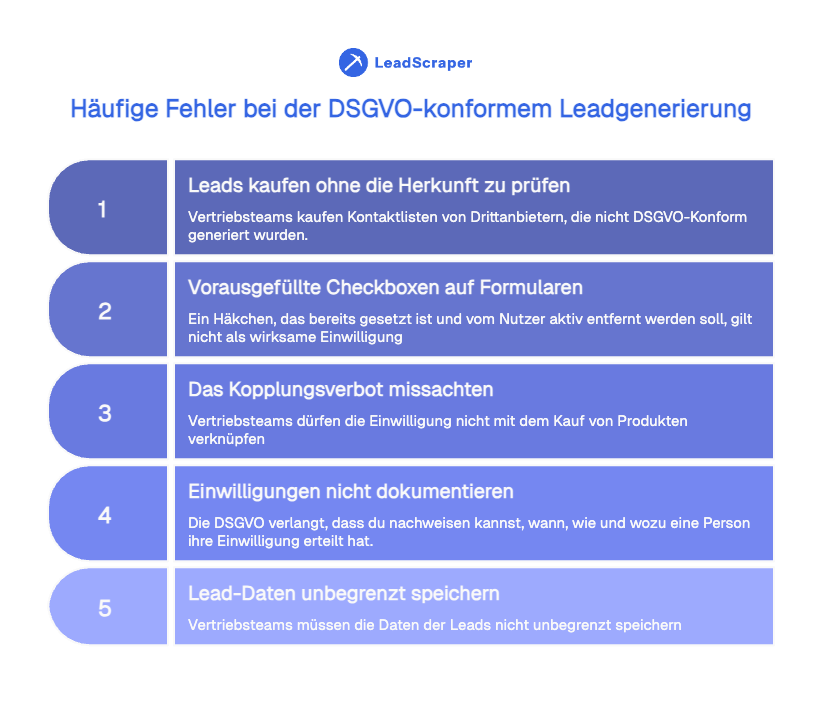
Many sales teams have good intentions but still fall into avoidable traps. Which mistakes are particularly common in daily operations?
1) Buying leads without verifying their origin.
At first glance, it seems tempting: a provider delivers ready-made contact lists with hundreds of potential customers, sorted by industry, region, and company size. You pay, download the list, and your sales team can get started.
The problem with this: Anyone who buys leads assumes full data protection responsibility for the use of this data. Can you prove that every person on the list has consented to their data being passed on to your company? In most cases, no. The lead broker may claim GDPR compliance, but ultimately the burden of proof lies with you.
What's more,: Purchased lists age quickly. Contacts change jobs, companies are restructured, phone numbers change. Your sales team will be calling into the void. And the same list you acquired, your competitors probably already have in their CRM. Warnings from competitors under the Unfair Competition Act (UWG) are also a real scenario.
2) Pre-checked boxes on forms
A checkbox that is already ticked and requires the user to actively untick it does not count as valid consent. The European Court of Justice clearly confirmed this in 2019. Consent requires a conscious, active action. Anything else is legally worthless.
3) Disregarding the prohibition of coupling
You may not make the provision of a product or service conditional on the customer simultaneously consenting to receive advertising. Downloading an e-book does not automatically mean consenting to the newsletter. Both require separate, voluntary consent.
4) Failing to document consents
The GDPR requires you to be able to prove when, how, and for what purpose a person gave their consent. Without this proof, you will have no evidence in case of a dispute. A timestamp and logging the opt-in process in the CRM system provide security. Many companies neglect precisely this step.
5) Storing lead data indefinitely
"Maybe we'll need the contact at some point" is not a valid legal basis for permanent storage. Define clear deletion periods and adhere to them. Many CRM systems offer automatic reminders or deletion routines that simplify this process.
Avoiding these mistakes significantly reduces the risk of fines and warnings. And honestly: clean processes also make everyday sales work more pleasant, because you focus on current, relevant contacts instead of outdated dead ends.
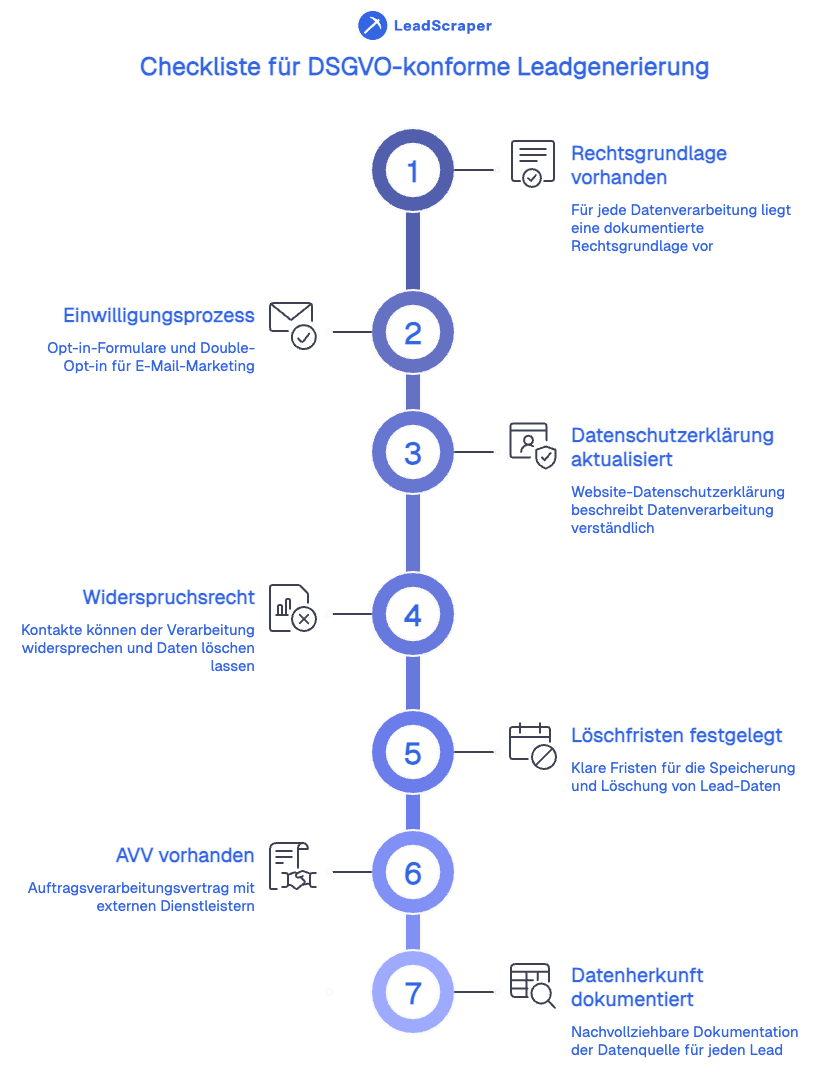
Checklist: Is Your Lead Generation GDPR-Compliant?
Before you launch your next campaign, a quick self-check is worthwhile. The following points will help you identify typical gaps:
- Legal basis documented? For every processing of personal data, a documented legal basis exists (consent or legitimate interest with a balancing of interests).
- Consents properly obtained? Opt-in forms include a separate, unchecked box. For email marketing, a double opt-in process is used.
- Privacy policy up to date? The privacy policy on your website clearly describes what data you collect, for what purpose, and on what legal basis.
- Option to object and delete available? Contacts can object to processing at any time and request the deletion of their data. This process is documented and works reliably.
- Retention periods defined? You have defined how long you store lead data and when it will be deleted if no business relationship is established.
- Data Processing Agreement (DPA) in place? If you use external tools or service providers for data processing, a DPA according to Art. 28 GDPR is in place.
- Data source traceable? For each lead, you can document where the data originated (self-collected, public source, third-party provider with consent).
Not every point applies equally to every lead generation method. However, as a basic framework, this list helps you rule out the biggest risks from the outset.
GDPR-compliant Lead Generation in Practice: 5 Proven Ways
Enough theory, enough warnings. How do you now acquire qualified B2B leads without incurring legal risks? Here are five methods that have proven effective in practice:
1. Content Marketing with Opt-in
You create a whitepaper, an e-book, or a webinar that solves a specific problem for your target audience. To download the content or participate, the interested party voluntarily provides their contact details via a form with legally compliant consent.
The advantage: The lead actively approaches you and has genuine interest in your subject area. This significantly increases the conversion rate in subsequent sales compared to cold lists.
2. Forms and Landing Pages with Legally Compliant Consent
Every landing page that collects personal data requires a clear declaration of consent.
Key considerations: only mandatory fields that are truly necessary (data minimization), a separate checkbox for consent to be contacted, a reference to the privacy policy, and a double opt-in process for newsletter registrations.
3. Using Publicly Available Business Data
Company websites, commercial registers, industry portals, and business directories contain a wealth of business data that companies intentionally make publicly available. You may use this data for B2B acquisition as long as you document a legal basis (e.g., legitimate interest) and inform the contact about the data processing.
The classic approach: You manually research company websites, in Google Maps or in industry directories. This works, but it's incredibly time-consuming. And this is precisely where modern tools come in (more on that in the next section).
4. Social Selling via LinkedIn and Co.
LinkedIn has long been a standard channel in B2B sales. You connect with decision-makers, share relevant content, and build relationships before pitching a specific offer. As long as you don't send mass messages with an advertising nature, you generally remain compliant with data protection regulations.
What about exporting LinkedIn contacts to your CRM? This is where it gets tricky. LinkedIn's terms of service restrict the scraping of profile data. Personalized direct outreach via the platform itself is the safer approach.
5. AI-Powered Real-Time Research from Public Sources
Imagine describing your ideal customer in a few sentences: “Mechanical engineering companies in Southern Germany with 20 to 100 employees that export internationally.”
And a system then searches the entire internet in real-time, filters out suitable companies, and provides you with the company name, website, email address, phone number, and the appropriate contact person. GDPR-compliant, because only publicly available business data is collected. We'll look at exactly how this works in the next section.
How AI-powered tools automate lead research and maintain GDPR compliance
Manual research for B2B contacts through company websites, directories, and industry portals is time-consuming. Yet, as you saw in the previous section, this very publicly available data provides a solid legal basis for lead generation.
The logical question is: Can this process be automated without violating the GDPR?
Yes, that's possible. And this is precisely where AI-powered tools come into play. However, not all of them work the same way. The difference lies in their approach.
Static lead databases collect and store contact data centrally. This data quickly becomes outdated, its origin is often opaque, and it's difficult to verify if the data subjects' consent has been obtained. Lead brokers go a step further, selling the same datasets to multiple companies simultaneously.
AI-powered real-time scraping from public sources operates on a different principle. Taking our example of AI tool LeadScraper.de this is how it works:
You describe your target audience in natural language using free-text fields. Hundreds of AI agents then search the internet, analyze company websites, directories, and industry portals, and compile a list of suitable contacts.
The data is not pulled from a database but researched at the moment you make the request.
What this means for GDPR:
- Only freely accessible business data is collected: company names, websites, publicly listed contact persons, and contact details.
- No purchase or resale of personal data takes place.
- The legal basis for processing is the legitimate interest in establishing business contact in a B2B context.
This way, you combine automated lead generation with GDPR compliance, without having to sacrifice the timeliness or relevance of contacts.
Conclusion: GDPR as an Opportunity for Better Leads
The GDPR forces you to look more closely: What data are you collecting, where does it come from, and do you really need it? This might initially sound like a restriction. In practice, however, it leads to your sales team working with fresher, more relevant, and higher-quality contacts.
Those who rely on self-generated leads or the use of publicly available business data are on solid legal ground. And for those who no longer want to handle manual research themselves, AI-powered tools like LeadScraper.de offer a solution that automates the entire process: GDPR-compliant, in real-time, and without a subscription commitment.
The sales of the future don't work with bigger lists, but with better ones. And the GDPR is not an obstacle, but rather the framework that makes this possible.
FAQ: Common Questions about GDPR-compliant Lead Generation
How long can I store leads in the CRM?
Personal data may only be stored for as long as it is needed for the original purpose. If no business relationship is established after several contact attempts, the legal basis for further storage ceases to exist. Set specific deletion periods in your CRM system and ideally set up automatic reminders or deletion routines. This prevents outdated data records from lingering in your database for years.
Do I need a separate opt-in for every webinar, whitepaper, or newsletter?
Yes. For each specific measure, a separate, documented consent is required. A blanket opt-in along the lines of “I agree to everything” is not sufficient and is not GDPR-compliant. Registering for a whitepaper does not automatically imply consent to newsletter distribution. Keep consents clearly separate; this protects you legally and ensures that you only contact individuals who genuinely want to be contacted.
Which tools support GDPR-compliant lead generation?
CRM systems with integrated data protection features, consent management platforms, and marketing automation tools help document consents and adhere to deletion periods. For acquiring new leads, AI-powered solutions like LeadScraper.de are suitable, as they exclusively evaluate publicly available business data in real-time and thus operate in a GDPR-compliant manner from the outset. The most effective approach is a combination of lead generation, CRM, and consent management that covers the entire lead lifecycle.
What to do in case of an access or deletion request?
Data subjects have the right, under Art. 15 and Art. 17 GDPR, to receive information about stored data or to request its deletion. For this, you need a clearly defined process: Who receives the request? In which systems is the data stored? How do you ensure that the deletion is complete and timely (usually within one month)? Document this process in writing and test it regularly. Because a request that gets lost in the inbox can quickly become a data protection incident.
Is the use of publicly available company data allowed for prospecting?
Generally, yes. Data that companies deliberately publish on their websites, in commercial registers, or industry directories may be used for business contact. The legal basis is usually legitimate interest. Nevertheless, general GDPR obligations apply: You need a defined processing purpose, may not store the data indefinitely, and should inform the data subject about its use.
Tools like LeadScraper.de use precisely this principle and automate research from public sources.
What is the cost of a GDPR violation in lead generation?
The GDPR stipulates fines of up to 20 million Euros or four percent of the global annual turnover, whichever amount is higher. In practice, penalties are usually lower, but even five-figure fines can be painful, especially for small and medium-sized enterprises. Additionally, there may be warnings from competitors under the UWG (Unfair Competition Act) and claims for damages from affected individuals.
The most secure protection: setting up clean processes from the very beginning.