
.svg)
.svg)
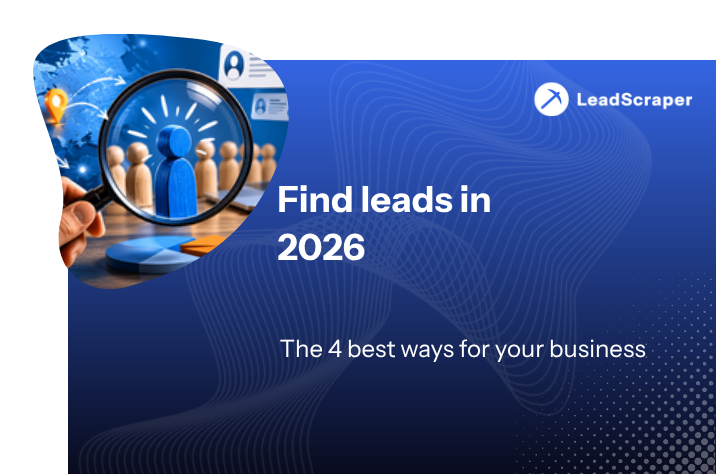
Finding Leads: The 4 Best Ways for Your Business
%2520(7).jpeg)
Generate B2B Leads with AI?
With LeadScraper, you create suitable B2B lists in seconds. 100% GDPR compliant. No subscription required!
CREATE TEST ACCOUNTMost sales teams don't fail at selling. They fail at getting enough suitable contacts on the table in the first place. Hours spent researching companies, hunting down email addresses, maintaining lists, and in the end half the contacts are outdated or don't fit at all. That this is no isolated case is shown by a Salesforce study. Sales reps spend less than 30% of their time actually selling, the rest goes to tasks like research and admin.
In this guide you get an organized overview of every way you can find leads today. From classic self-research through inbound to AI-powered lead search.
- Finding leads means actively searching for suitable contacts (outbound sourcing). Generating leads means prospects come to you on their own (inbound). The best teams combine both.
- There are four basic ways: research yourself, attract leads, buy addresses, and find them automatically with AI.
- Without a clear ideal customer profile (ICP) you find many contacts, but rarely the right ones.
- Buying signals such as job postings or a specific tech stack show you which companies have a real need right now.
- In Germany, B2B outreach from publicly accessible sources is allowed as long as there is a factual connection between your offer and the company.
Finding leads or generating leads: what is the difference?
Finding leads means you take action and search for suitable companies and contacts yourself. Generating leads means you create content and offers through which prospects find you and reach out to you.
You go to the leads. Research via LinkedIn, directories, Google Maps or AI. Ready to go fast, you have a list right away.
The leads come to you. Content, SEO and lead magnets. Longer to build, but a higher close rate.
The difference is more than splitting hairs, because it determines how quickly you see results. Whoever actively finds leads has a list of contacts tomorrow and can get started. Whoever relies on inbound builds reach over months and harvests later, but usually with a higher close rate, because people reached out themselves.
Both directions have their place. According to a Gartner survey, 61% of B2B buyers prefer a rep-free buying process, so they would rather research on their own before talking to anyone. That is exactly why inbound pays off. At the same time, hardly any sales team likes to wait months for the first lead. Active finding fills the pipeline immediately.
The first step: your ideal customer profile
Before you apply any method, you need a clear picture of who you are actually looking for. This ideal customer profile (ICP) determines the quality of every list you build later.
A good ICP describes more than just the industry. It covers company size, region, business model, typical challenges and the role of the person you want to address. The more precise this profile, the less waste you have later. Whoever skips this collects many addresses and only realizes in the conversation that the companies have no need at all.
In my experience this is the most common reason for frustrating acquisition. The method was never the problem, the target picture was too blurry. If you work cleanly here, every following step gets easier. You will find a detailed guide on this in our article on the ideal customer profile for B2B leads.
The best ways to find leads: the overview
There are four basic ways to get leads. Each has its own strengths, and most successful sales teams combine two or three of them. The following table shows you what to expect from each way.
| Way | Effort | Cost | Speed | Scalability | B2B fit | Lead quality |
|---|---|---|---|---|---|---|
| Research yourself | High | Low | Medium | Low | Very good | High |
| Attract leads (inbound) | High | Medium | Slow | High | Good | Very high |
| Buy addresses | Low | Medium to high | Fast | High | Medium | Variable |
| Find with AI | Low | Medium | Fast | Very high | Very good | High |
Which way fits you depends mainly on your target group and your time horizon. If you serve a very specific niche, pure inbound often won't reach the few suitable companies fast enough. Then active research or an AI-powered search is the better choice. If your target group is broad and you have time, inbound builds you the highest-quality leads. If you need volume immediately and can live with variable quality, buying addresses is an option you should think through carefully.
Way 1: Research leads yourself
Researching yourself is the most direct way and costs mainly time. You go specifically to where your target customers are publicly visible and build your list contact by contact. Lead quality is high because you deliberately select every company.
LinkedIn and Sales Navigator
In B2B, LinkedIn is the most important platform for manual research. Through search you filter by industry, location, company size and job title and find the right contacts directly. Sales Navigator extends these filters considerably and also shows you contacts outside your network.
How strong LinkedIn is in B2B is shown by a number from LinkedIn itself. 80% of all B2B leads from social media come from the platform. But watch the limits. LinkedIn restricts the number of connection requests per week, and whoever automates too aggressively risks a ban. If manual search is too slow for you, it's worth a look at alternatives to Sales Navigator.
Company databases and industry directories
Industry directories, commercial register extracts and public company profiles are a solid source of structured data. You find company names, addresses and often phone numbers there and can narrow down by industry and region.
The advantage is completeness, the drawback is how current the data is. Directories are not always maintained, and you often have to top up contact data by phone or via the website. For targeted regional outreach they are strong nonetheless.
Google Maps and local sources
Google Maps is often underrated as a lead source. Whoever has a local or regional offer finds structured business data there with address, phone number, website and reviews. You search by industry plus location and work through the results.
For trades, local service providers and regional sales in particular, this is a free gold mine. How to go about it systematically we show you in detail in our article on finding companies near you.
Trade fairs, events and referrals
In the early stage, personal contacts often beat any digital channel. At trade fairs, industry meetups and local events you meet people who already have an interest in your topic. Business cards and a short, clear pitch are enough to make the first contact.
Referrals are especially valuable, because referred contacts come with a head start of trust and convert more easily. Actively ask your satisfied customers for suitable contacts instead of waiting for them.
In a discussion on r/smallbusiness one founder reports that 4 out of 5 of his customers come from in-person events and only one from LinkedIn. The tenor of many replies is that local networking beats everything in the early stage. Cold outreach only works if real research was invested beforehand.
Way 2: Attract leads (inbound)
With inbound you reverse the direction. Instead of searching yourself, you make sure your target group finds you and reaches out on its own. This takes longer to build, but delivers the highest-quality leads, because people already have a need.
How important this way is becoming is shown by a number from the Demand Gen Report. In 80% of cases B2B buyers make first contact themselves, often only once they are about 70% through their research. Whoever is visible during this research phase lands on the list. You will find a detailed guide in our article on B2B lead generation with a system. Here just the most important levers in brief.
Content and SEO: getting found online
With helpful content on your target group's questions you become visible in search engines and increasingly in AI answers too. Blog posts, guides and comparisons that solve real problems attract visitors continuously over months. That is the engine of every inbound strategy.
Website, landing page and lead magnets
Your website turns visitors into contacts. A clear lead form and an attractive lead magnet, such as a checklist, an e-book or webinar access, give visitors a reason to leave their contact data. Keep the form short, because every extra field lowers the completion rate.
Social media, webinars and more
Through social selling on LinkedIn, regular posts and webinars you build reach and trust. Webinars are especially good, because attendees have already shown their interest by signing up. The key is consistency, because inbound rewards patience.
Way 3: Buy leads and addresses
Buying addresses or ready-made lead lists is the fastest way to volume and at the same time the riskiest when it comes to quality. You get a large number of contacts immediately, but often don't know how current and how suitable they are.
Bought lists have two weak spots. First, contact data ages quickly, which leads to high bounce rates and a damaged domain reputation. Second, the contacts rarely match your ICP exactly, because they were compiled for many buyers at once. If you go this way, look for reputable, GDPR-compliant sources with traceable origin and regular updates.
Whether buying is worth it for you and what to watch out for we have covered in detail in our article on buying B2B leads.
Way 4: Find leads automatically with AI
AI-powered lead search combines the best of the other ways. It searches as precisely as manual research, but delivers the speed and scalability of buying data. Instead of clicking through directories and profiles yourself, you describe your target group and software takes over the research.
This is exactly where the biggest gap lies in most guides on the topic. While LinkedIn and trade fairs have been written about for years, automated lead search via AI is the area changing the fastest right now.
How AI-powered lead search works
Modern lead tools search publicly accessible sources in real time and compile suitable company contacts from them. With LeadScraper you describe your target customers, for example, in several free-text fields in your own words instead of clicking through rigid dropdown filters. Hundreds of AI agents then search the internet and deliver an individual lead list with company name, website, email, phone number and the right contact person.
The difference from a database is freshness. Every list is generated anew and not pulled from a fixed stock that everyone else uses too. The model is credit-based, so you spend credits specifically on the research you really need.
Finding niches and complex target groups
The real strength of AI search shows with specific target groups. A list of all dental practices in Germany you can get anywhere. It gets interesting when you look for dental practices that specialize in private patients and use a specific device.
Such complex criteria can hardly be mapped with classic filters. An AI that interprets free text semantically can hit exactly such niches. Through a thumbs-up and thumbs-down rating after each request, the system also learns along, so the results get more precise with every use.
AI and humans: why semi-automation wins
Automation has a limit, and it lies at the conversation. AI is excellent at finding and preparing leads. At the actual contact, humans beat the machine.
On r/sales one user nails it: “I get twelve of these dumb AI-generated emails every day, it's annoying and obviously fake.” The consensus in the r/b2bmarketing discussion clearly leans toward semi-automation. AI handles research and preparation, the human takes over from the first real reply.
So use AI for what it does well. Let it find suitable companies, enrich contact data and make suggestions. The personal, short outreach you write yourself. This combination beats both pure manual work and fully automated mass sending.
Use buying signals: find leads with a real need
A lead that has a need right now is worth considerably more than one that only fits your profile on paper. You recognize this current buying readiness by so-called buying signals.
There are many concrete signals. An open job posting for a specific role points to growth or a new project. Certain keywords on the company website show that a company is working on exactly your topic. The tech stack in use also reveals whether your solution fits it. Even negative reviews on employer platforms can be used, for instance as a hook if you offer HR solutions.
A matching vacancy points to growth or a new project.
Certain terms show that a company is working on exactly your topic.
The software a company uses reveals whether your solution fits at all.
Negative employer or product reviews provide the right hook.
Whoever filters leads by such signals saves themselves many cold conversations. Which signals are especially meaningful in B2B and how to capture them systematically we show you in the article on recognizing buying signals in B2B.
Finding leads and GDPR: what is allowed in Germany
In B2B you may research and contact companies from publicly accessible sources, as long as there is a factual connection between your offer and the company. This makes active lead search fundamentally legally feasible.
For outreach there are clear rules. You may contact commercial customers by phone if you can presume a legitimate, factually justifiable interest. Private consumers may neither be called nor emailed for advertising without explicit consent. For advertising emails, § 7 (2) no. 2 UWG applies without exception: they always need prior express consent, even when they go to a company. For newsletters and bulk mails this runs via the double opt-in procedure.
- Calling commercial customers with a factual connection to the offer
- Postal mail to companies
- Research from publicly accessible sources
- Calling private individuals without consent
- Advertising email or SMS without prior consent, including to companies
- Newsletter without double opt-in
What matters is the source of your data. Whoever works exclusively with publicly accessible information, such as company websites, industry directories and public profiles, is on much safer ground than someone who buys personal data. The legal details we have prepared in our article on GDPR-compliant lead generation.
The most common mistakes when finding leads
Most problems in lead search rarely come down to the method. They arise from avoidable mistakes in execution. These five you see most often.
Whoever doesn't know who they're looking for collects many unsuitable contacts. Sharpen the profile first, then research.
Fully automated mass sending sounds like a robot and burns good chances. Personal outreach stays handmade.
Bought addresses without verified quality lead to high bounce rates and harm your domain reputation.
A short, personal message with a real connection beats a hundred generic emails. Five minutes of research per contact pays off.
Duplicate and outdated contacts cost time and distort your numbers. Clean your data regularly.
Conclusion
Finding leads today is above all a question of method. The four ways, researching yourself, attracting, buying and finding with AI, all have their place, and the strongest sales teams combine them. What matters is that you start with a clear ideal customer profile, because that determines the quality of every list.
If you need a filled pipeline immediately, active research and AI-powered lead search are the fastest way. With specific niches in particular, an AI that understands your target group in your own words plays to its strength. Inbound you build in parallel, because in the long run it delivers the highest-quality leads. Pay attention to clean data sources and GDPR throughout, and in the end you will find the leads that really move your sales forward.
Frequently asked questions (FAQ)
How do I find leads for free?
For free works through manual research. Google Maps, public industry directories and the basic LinkedIn search deliver suitable contacts without tool costs. You invest time instead of money. Whoever regularly needs larger volumes will quickly hit limits with pure manual work though.
How do I find leads with a current need?
Through buying signals. Open job postings, certain keywords on the website or a matching tech stack show which companies have a need right now. If you filter by these signals, you address companies where the timing is right, instead of searching purely by profile attributes.
Are bought leads worth it?
Bought leads deliver volume quickly, but vary strongly in quality. They make sense if the source is reputable and GDPR-compliant, the data is kept current and individually filterable. Blindly bought mass lists, on the other hand, mostly lead to high bounce rates and weak response.
How do I find the right contacts?
Through LinkedIn and the company website you find out who is responsible for your topic in the company. The goal is to reach the person with decision-making influence directly and not to end up with the assistant or a general address. How to reliably identify decision-makers we show you in the article on finding the right contact person.