
.svg)
.svg)
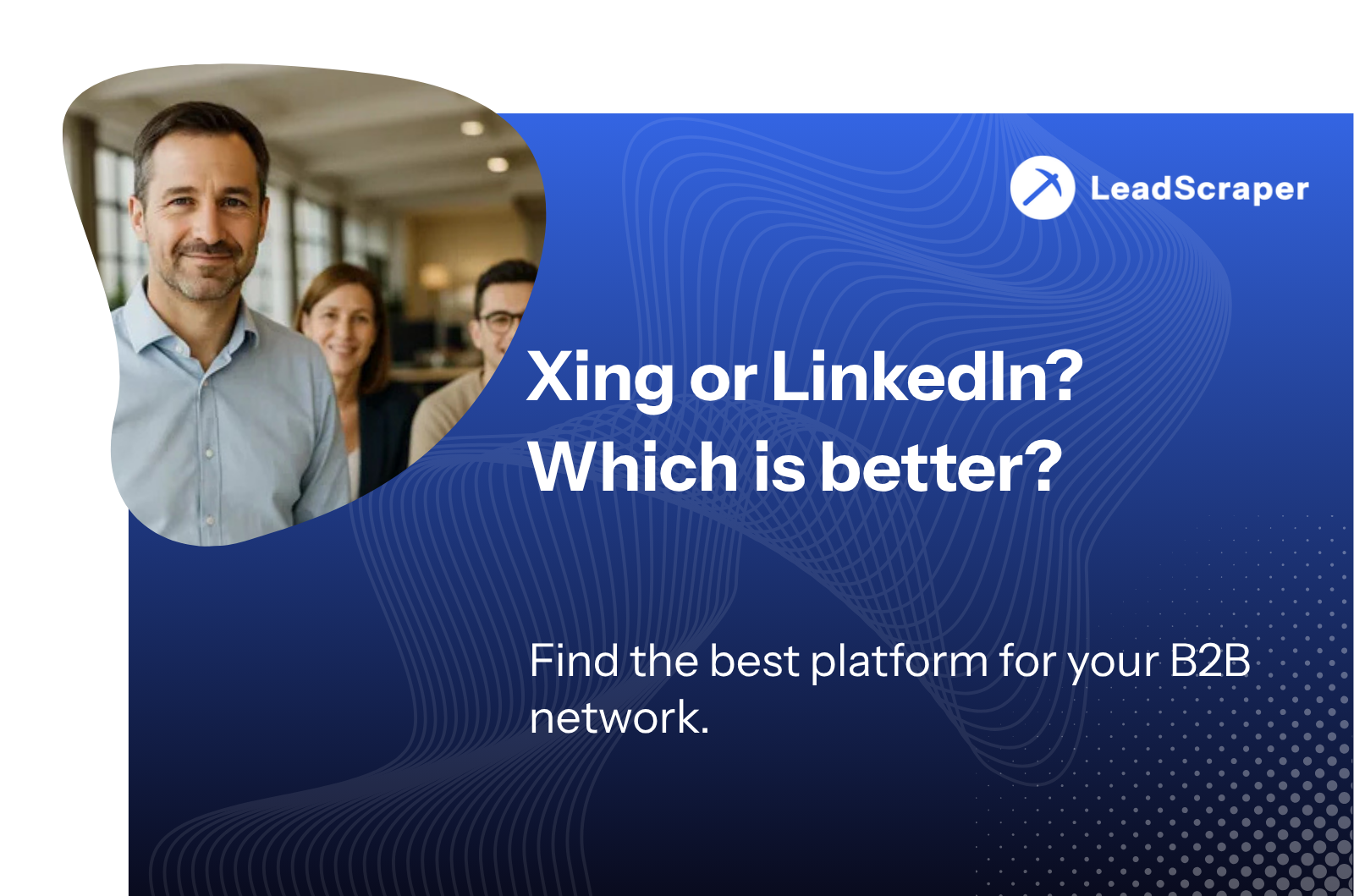
Xing or LinkedIn: Which platform is worthwhile for B2B sales?
%2520(7).jpeg)
Generate B2B Leads with AI?
With LeadScraper, you create suitable B2B lists in seconds. 100% GDPR compliant. No subscription required!
CREATE TEST ACCOUNTLinkedIn or Xing – this question has been on the minds of B2B sales professionals in the DACH region for years. The answer is clearer today than ever before, as Xing has fundamentally changed over the past two years. Those who aren't aware of this are wasting time on the wrong platform.
- Since 2023, Xing has transformed from a business network into a pure job and recruiting portal – for active B2B sales, the platform is hardly relevant anymore today.
- In February 2025, LinkedIn surpassed the mark of 26 million users in the DACH region and is growing by around 17 percent per year – decision-makers and executives are disproportionately well represented there.
- For B2B lead generation in the DACH region, LinkedIn is the clear choice. Xing is, at best, still worthwhile for companies in traditional HR or recruiting industries.
Xing is no longer what it used to be
Since 2023, Xing has focused almost exclusively on job searching and recruiting. The platform has gradually dismantled its business networking features: group feeds have been discontinued, the content feed has lost relevance, and the algorithm now prioritizes job postings and career content. Anyone looking for decision-makers on Xing will quickly find profiles that haven't been actively maintained for months or even years.
This is no coincidence; it's a deliberate strategy. New Work SE, Xing's parent company, has intentionally steered the platform towards the job market. For B2B sales professionals, this specifically means: the target audience you might reach there is looking for a new job, not new service providers or products.
LinkedIn Dominates the DACH Market for B2B Contacts
Today, LinkedIn is the dominant platform for professional networking in the DACH region. In February 2025, the platform surpassed 26 million members in Germany, Austria, and Switzerland. Growth is around 17 percent per year, and the proportion of active decision-makers and executives is exceptionally high. Globally, over 65 million decision-makers are registered on LinkedIn, with 10 million of those in C-level positions alone.
This directly impacts reachability. When it comes to Outbound via LinkedIn, you reach buyers, managing directors, and sales managers in an environment where they are actively seeking professional insights and are open to conversations. This underlying sentiment is missing on Xing.
What LinkedIn Offers for Sales That Xing Cannot
LinkedIn is not just a contact database; it's a complete sales ecosystem. Sales Navigator allows for precise searches by industry, company size, function, and seniority. InMail messages can reach people outside your network. Additionally, native integrations with CRM systems like HubSpot, Pipedrive, or Salesforce significantly simplify the transition from initial contact to the sales process.
Xing offers no comparable sales tools. Contacts can be searched, but the hit rate is significantly lower, automations are barely possible, and CRM integrations are practically non-existent. Anyone who today systematically engages in LinkedIn sales, has a measurable advantage over those who still rely on platforms that are no longer evolving.
Content Marketing and Visibility: Only LinkedIn Offers Genuine Reach
Specialized articles, short posts, videos, surveys – on LinkedIn, content functions as a sales tool. A well-structured post can organically reach thousands of professionals without you spending a cent on advertising. Decision-makers comment, share, and make contact when the content is relevant. This is Social Selling in its most effective form.
In my assessment, this is LinkedIn's underestimated advantage: Anyone who regularly posts clear, practical content builds recognition within their target audience over months, without actively having to cold outreach. This dynamic is missing on Xing. The feed is sparse, the interaction rate is low, and the audience simply isn't there anymore.
LinkedIn vs. Xing: A Direct Comparison
| Criterion | ||
|---|---|---|
| Users DACH (2025) | 26 million | approx. 21 million |
| Platform focus | B2B networking, sales, content | Job search, recruiting |
| Active decision-makers | High (65 million worldwide) | Low, declining since 2023 |
| Sales Navigator | Yes, comprehensive | No |
| CRM integration | HubSpot, Pipedrive, Salesforce, etc. | Barely available |
| Content reach | High, organically scalable | Low, feed heavily reduced |
| Outbound suitability B2B | Very good | Limited |
| AI and automation tools | Numerous third-party integrations | None worth mentioning |
| International reach | 1.1 billion users worldwide | DACH region |
When Xing Might Still Be Relevant
Xing is not entirely worthless. For HR departments, headhunters, and companies actively seeking skilled professionals, the platform remains a useful tool. The recruiting section is still active, and in traditional German mid-sized industries such as mechanical engineering, skilled trades, or construction, there are still target groups active on Xing.
However, if you want to approach decision-makers to sell products or services, the effort on Xing is hardly worthwhile anymore. The platform is no longer the right place for that. Today, I would at most maintain Xing as a passive presence, but not invest any active sales energy there.
LinkedIn and Specialized Tools: How to Build Your Lead Pipeline
LinkedIn is the starting point, but not a complete system for systematic B2B lead generation. The platform shows you who someone is, but it doesn't tell you which companies are actively looking for a solution you offer. For that, you need additional research tools.
Specialized tools like LeadScraper complement LinkedIn effectively: Instead of manually searching profile by profile, you can precisely define who you're looking for using a free-text description and receive a freshly generated list with verified contact details. This saves time that you can then use for the actual outreach on LinkedIn. If you then also understand how to use LinkedIn specifically for DACH lead generation , you'll have a functioning pipeline.
Conclusion: LinkedIn is not an option, but a standard
Xing and LinkedIn are no longer equivalent alternatives today. Xing has deliberately withdrawn from B2B sales and has become a recruiting tool. LinkedIn, on the other hand, is the platform where B2B decision-makers in the DACH region are active, consume content, and prepare purchasing decisions.
If you are active in B2B sales, you should treat LinkedIn as an integral part of your process: optimize your profile, post content regularly, and use Sales Navigator for targeted searches. How to correctly phrase your first contact, often makes the difference between a response and silence. You can keep Xing as a passive presence, but your active sales time belongs on LinkedIn.
Frequently Asked Questions about Xing and LinkedIn in B2B Sales
Is Xing still relevant for B2B companies?
For active B2B sales, Xing is hardly relevant anymore today. Since 2023, the platform has focused on job search and recruiting. Decision-makers you want to acquire as customers are significantly less active there than on LinkedIn.
Is LinkedIn Sales Navigator really worth it?
Yes, for teams with regular outbound needs, Sales Navigator is worth it. It enables precise searches for target groups and significantly saves time on research. For smaller teams or individuals, the free profile with a targeted content strategy may also suffice.
Can I use LinkedIn and Xing simultaneously?
Technically yes, but the effort is rarely worth it. LinkedIn requires regular activity to build reach. Your time is better invested if you focus on LinkedIn and at most maintain Xing as a passive presence.
How many decision-makers are active on LinkedIn?
Worldwide, according to LinkedIn over 65 million decision-makers and 10 million C-level executives active on the platform. In the DACH region, approximately 26 million people used LinkedIn in February 2025 – with an above-average proportion of specialists and executives.
What alternatives are there to LinkedIn for B2B leads?
LinkedIn is the strongest platform for direct outreach. For preliminary research, i.e., finding the right contacts in your target group, specialized lead generation tools effectively complement the platform. You can find an overview of the most common approaches in our article on effective lead research.